
|
You are here
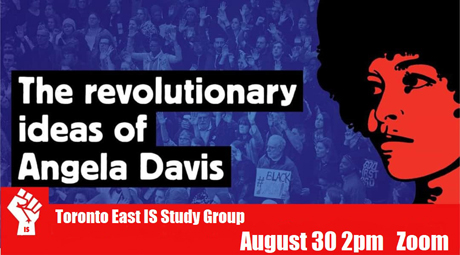
The revolutionary ideas of Angela Davis
Location
zoom
toronto
, ON
Canada
See map: Google Maps
Ontario CA
The Toronto East International Socialists presents
The revolutionary ideas of Angela Davis
Introduction by Virginia Rodino, member of Marx21 US
Join us for this important discussion - to join click the Zoom link (full details below)
Angela Davis is a hugely influential socialist, feminist and prison abolitionist writer and intellectual who rose to prominence in the Black Power movement of the late sixties and early seventies.
Anti-Vietnam War and a member of the Communist party and a lifelong fighter against racism and injustice, she was clear that "we can't eradicate racism without eradicating capitalism". She worked for prison abolition and campaigned for the rights of prisoners.
In 1970 she faced trial on charges of kidnapping, murder and conspiracy connected to a deadly confrontation in Marin county California. A brilliant worldwide movement campaigned for her release; she was acquitted in 1972 and later that year published her autobiography, Angela Davis: An Autobiography by Angela Y. Davis.
Through the years she has written on a wide variety of subjects, from aesthetics to feminism to prison abolition, to which she returned again and again. She analyzed what she called the prison-industrial complex, as the war on drugs and laws like the third strike law led to increased incarceration rates, particularly among Black men in the '80s and '90s. Davis has written and campaigned tirelessly for the abolition of prisons up to the present day.
In probably her most widely read book, Women, Race and Class, Davis examines the dynamic between oppression and exploitation in capitalist society.
She opposed the war on terror in 2001 following 9/11, and the subsequent invasions of Afghanistan and Iraq.
She was one of the earliest supporters of Palestine Liberation on the American left, and her support continues to this day.
She is currently Distinguished Professor Emerita with UC Santa Cruz.
Zoom Meeting Details:
https://us02web.zoom.us/j/
Meeting ID: 860 0385 0306 Passcode: 848061
Meeting ID: 860 0385 0306 Passcode: 848061
Toronto Dial-in numbers: +1 647 374 4685 +1 647 558 0588
Suggested Reading List:
socialist worker (UK) article - an overview of her life campaigning against racism and injustice for over 35 years
Series of 3 articles from Socialist Review
From Segregation to Black Liberation (Oct 2019)
Angela Davis: America's Most Wanted (Nov 2019)
Angela Davis: An Icon and an Inspiration (Feb 2020)
Women, Race, and Class by Angela Y. Davis
A powerful study of the women's movement in the U.S. from abolitionist days to the present that demonstrates how it has always been hampered by the racist and classist biases of its leaders.
Additional Reading
Freedom Is a Constant Struggle: Ferguson, Palestine, and the Foundations of a Movement
In these newly collected essays, interviews, and speeches, Davis illuminates the connections between struggles against state violence and oppression throughout history and around the world. Reflecting on the importance of black feminism, intersectionality, and prison abolitionism for today's struggles, Davis discusses the legacies of previous liberation struggles, from the Black Freedom Movement to the South African anti-Apartheid movement. She highlights connections and analyzes today's struggles against state terror, from Ferguson to Palestine. Facing a world of outrageous injustice, Davis challenges us to imagine and build the movement for human liberation. And in doing so, she reminds us that "Freedom is a constant struggle."
In these newly collected essays, interviews, and speeches, Davis illuminates the connections between struggles against state violence and oppression throughout history and around the world. Reflecting on the importance of black feminism, intersectionality, and prison abolitionism for today's struggles, Davis discusses the legacies of previous liberation struggles, from the Black Freedom Movement to the South African anti-Apartheid movement. She highlights connections and analyzes today's struggles against state terror, from Ferguson to Palestine. Facing a world of outrageous injustice, Davis challenges us to imagine and build the movement for human liberation. And in doing so, she reminds us that "Freedom is a constant struggle."
Angela Davis: An Autobiography by Angela Y. Davis
Her own powerful story to 1972, told with warmth, brilliance, humor and conviction, with a 1988 Introduction by the author.
The Angela Y. Davis Reader (Joy James - Editor)
18 essays from her writings and interviews organized in four parts - "Prisons, Repression, and Resistance", "Marxism, Anti-Racism, and Feminism", "Aesthetics and Culture", and recent interviews - Davis examines revolutionary politics and intellectualism.
The Meaning of Freedom by Angela Y. Davis
In this collection of twelve searing, previously unpublished speeches, Davis confronts the interconnected issues of power, race, gender, class, incarceration, conservatism, and the ongoing need for social change in the United States. She explores the radical notion of freedom as a collective striving for real democracy—not a thing granted by the state, law, proclamation, or policy, but a participatory social process, rooted in difficult dialogues, that demands new ways of thinking and being.
If They Come in the Morning by Angela Y. Davis
The trial of Angela Yvonne Davis in connection with the prisoner revolt by three black prisoners on August 7, 1970 at the Marin County Courthouse will be remembered as one of America's most historic political trials, and no one can tell the story better than Miss Davis herself. This book is also perhaps the most comprehensive and thorough analysis of that increasingly important symbol — the political prisoner.
Dates:
Sunday, August 30, 2020 - 02:00
Organized by:
Toronto East International Socialists


Featured Event

Events
-
October 4, 2026TorontoOrganized by:International Socialists
Recent Videos


Visit our YouTube Channel for more videos:

Visit our UStream Channel for live videos: