|
You are here
Can violence be moral?
Location
online via zoom
Vancouver
, BC
Canada
See map: Google Maps
British Columbia CA
Can Violence be Moral?
Understanding Palestinians' Use of Violent Resistance through Frantz Fanon's Perspectives on De-colonization and National Liberation
Thursday June 27
5:00 PM PDT
via Zoom
Register here to receive an email with the meeting link.
If one examines the history of colonialism (and settler-colonialism), there appears to be a consistent pattern: the moral dismissal of non-state perpetrators of violence - via the label "terrorist" - for example - with the Houthi rebels in Yemen, Hamas in Gaza, Hezbollah in Lebanon, and many others throughout history.
Perpetrators of violence are always portrayed as acting outside the boundaries of morality, and violence itself is regularly dismissed as irrational or subject to reductive explanations: the assertion of the perpetrator's lack of self-control, their dehumanization (as they are usually an "other"), or ascribing to them sadistic and psychological tendencies. But is it justified to lump all acts of violence in the same category with resistance movements such as those in Palestine, fighting against foreign occupations that they consider illegitimate? Why are those that are engaged in acts of physical violence deemed "extremists" while those who accept or work with foreign occupying forces deemed "moderates"? Who decides, and what is the criteria?
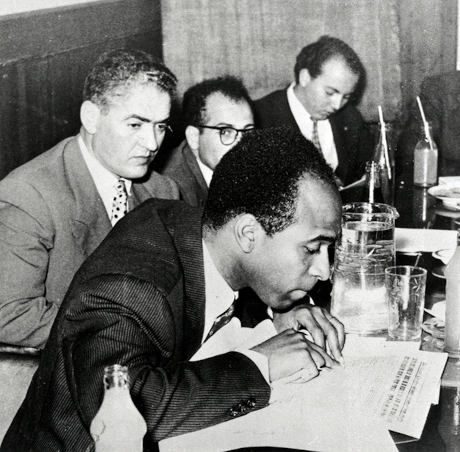
With this, we approach Frantz Fanon in "Wretched of the Earth". The excerpts below highlight both the practical and psychological reasons for violence against the colonizer:
"He [the native] (Palestinians in our context) of whom they have never stopped saying that the only language he understands is that of force, decides to give utterance by force. In fact, as always, the settler (Israelis in our context) has shown him the way he should take if he is to become free."
"At the level of individuals, violence is a cleansing force. It frees the native from his inferiority complex and from his despair and inaction; it makes him fearless and restores his self‑respect."
According to Fanon, colonial rule is sustained by violence and repression. With violence as the "natural state" of colonial rule, it follows that in fact it is the colonizers who only speak and understood the language of violence. As such, only the use of violence by the colonized can physically restructure society. Furthermore, Fanon argues that psychologically, violence returns agency to the colonized who were hitherto dehumanized, and allows them to recreate themselves in a light that is not tainted by the colonizers. In "Black Skin, White Masks", Fanon states that freeing oneself of colonialism through violence can be "cathartic". In the context of the Algerians, violence was cathartic as it allowed them to restore the "self" which was systematically destroyed by colonialism. Thus, Fanon theorises that violence enables the colonized to restructure their country politically, and also recreate themselves and resume a self-determining existence.
Despite this, Fanon did not think that violence was an end in itself. He constantly expressed the physical and human cost of violence. He also stressed that mere violence, without a clear plan for decolonization, would only reproduce the power relations of the colonizer. In addition, he claims that despite reclaiming land and power, violence will not be able to ease the creation of a new national identity after overthrowing the colonizers.
Without denying the potential of violence to be moral or immoral, understanding Fanon's thoughts on violence as both a creative and cathartic, yet limiting power for the colonized, allows us to look at other revolutionary movements - whether anti-colonial or anti-establishment - as surges or collective movements acting against perceived aggressors, rather than in conformity with universal moral norms.
Suggested reading: “For the outcasts and by the outcasts”: understanding all of Fanon’s warnings
Dates:
Thursday, June 27, 2024 - 17:00
Organized by:
Vancouver branch of the International Socialists


Featured Event
Events
-
September 27, 2026TorontoOrganized by:International Socialists and Marx21
-
October 4, 2026TorontoOrganized by:International Socialists
Recent Videos


Visit our YouTube Channel for more videos:

Visit our UStream Channel for live videos: