|
Features
You are here
Disaster capitalism, climate crisis and Indigenous Sovereignty
July 17, 2025
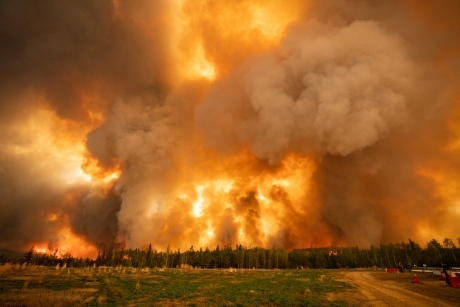
Two months into another devastating wildfire season, an area the size of southern Ontario has burned making it already Canada’s 4th worst wildfire season ever.
Saskatchewan premier Scott Moe and Manitoba premier Wab Kinew declared a state of emergency on May 29, after northern Saskatchewan First Nations complained of critical shortages in firefighting resources, personnel and air support.
At least 42,000 people have been evacuated – including members of Indigenous nations in BC, northern Ontario and Manitoba.
While some have started to return, members of the Pukatawagan Cree First Nation in northern Manitoba may not make it back home until November.
This community was also evacuated in 2023 when a record 17 million hectares of forest was burned, evacuating up to 230,000 people.
In 2023 carbon emissions from wildfires in Canada were greater than the total emissions from many nations and four times Canada’s official carbon budget.
Burned out forests lose their capacity to absorb atmospheric carbon for a generation.
Despite this, there is still no federal fire-fighting agency, and provinces won’t properly fund operations. In 2023, Mark Belanger, the president of OPSEU Local 713 representing around 300 wildland firefighters in Thunder Bay decried dangerous conditions and low pay. This year, three of Ontario’s water bombers remain grounded because pay is too low to attract pilots, and the 6 additional planes Doug Ford has ordered won’t arrive for up to a decade.
This January’s fires in LA notably devastated the Altadena neighbourhood – an area of historic black home ownership with a vibrant and diverse cultural legacy.
A month later, torrential rains from an “atmospheric river” hit LA causing flooding and mudslides on fire ravaged hills. This rapid transition between weather extremes has been dubbed “climate whiplash”, which is affecting many regions of the globe.
The impacts of the climate crisis have spread disaster faster than experts predicted: flooding in India in early June submerged 740 villages and 6,000 hectares of cropland, affecting over 260,000 people and killing over 70 people; deadly heat domes, like those that spread across Canada and the U.S. in June, have created dangerous living and working conditions worldwide; hurricanes, tornadoes and derechos more quickly develop into high intensity and deadly events; rising sea levels continue to threaten especially small, low-lying islands in the south pacific and coastal cities; hotter, dryer conditions in agricultural areas have led to drought and famine for millions.
People are being driven from their homes and communities – at least 218 million people have been internally displaced over the past ten years. Those driven across international borders are not yet recognized as “climate refugees”.
The impacts disproportionately affect people in the Global South, and Indigenous, racialized and marginalized people everywhere across the globe.
It is the consequence of imperialism where powerful states compete economically and militarily to dominate the globe. Imperialism originated with the dominant powers carving up the world over centuries through violence, dispossession, humiliation, racism and criminalization. Israel’s genocidal attacks on Gaza fit this pattern, as do Trump’s attacks on immigrants.
UN climate talks are blocked from meaningful action because powerful states must control fossil fuel production to win the economic and military competition.
Capitalism’s origins began with genocide and slavery – as Karl Marx wrote in Capital Volume 1:
The discovery of gold and silver in America, the extirpation, enslavement and entombment in mines of the [Indigenous] population, the beginning of the conquest and looting of the East Indies, the turning of Africa into a warren for the commercial hunting of black-skins, signalized the rosy dawn of the era of capitalist production.
Anti-Black and anti-Indigenous racism, and white supremacy, became necessary for rulers to justify imperialism and colonialism. Within states bosses combine these ideas with sexism, 2SLGBTQIS+ oppression, casteism and other oppressions to divide the working majority, whose labour is the source of their profits.
Class exploitation in settler colonial states like the US and Canada is built on land stolen from the many autonomous Indigenous nations that live(d) on Turtle Island for many thousands of years. European colonists justified this land theft using the racist “Doctrine of Discovery”. Historian Jennifer Reid called it “the legal means by which Europeans claimed rights of sovereignty, property and trade in regions they had allegedly discovered … without consultation with the resident populations to whom … the land actually belonged.”
These claims were enforced by violence. Prior to confederation, Indigenous nations were still populous and powerful, driving the British to enter treaties like the “Peace and Friendship Treaties” with the Mi’kmaq between 1752 and 1761. But when they were no longer needed they were disregarded by colonial forces, setting the pattern for treaties well into the 20th century.
After confederation, Canada’s first Prime Minister, John A MacDonald, championed the Canadian Pacific Railway to unite the colonies. He designed and implemented “Indian” policy as the first Minister of Indian Affairs. The North-West Mounted Police (forerunner to the RCMP) was created to break the resistance of the Plains Cree and Metis.
By 1888, the railway was complete, mass settlement of the West underway, and Indigenous peoples decimated and confined to tiny reserves. Canada accomplished this through horrific violence, starvation, unscrupulous treaty-making, the creation of the cruel residential “schools”, the theft of Indigenous children, the imposition of a tyrannical pass system, and the destruction of Indigenous governance structures and spiritual practices.
This was in order to break Indigenous traditions that undermined the accumulation of private property and fostered continuing resistance.
Residential “schools” humiliated Indigenous children so at graduation they had “lost everything Native except their blood,” in the words of Bishop Vital Grandin.
Around 150,000 First Nations, Inuit and Métis children passed through the “schools”, and between 6,000 and 25,000 died there.
This is an ongoing process: only the methods vary, ranging from violence to legal dispossession “under the sexist and racist provisions of the Indian Act”, as well as the “negotiation” of “land surrenders under the present comprehensive land claims policy”. The ends remain the same: to access “Indigenous peoples’ territories for … state formation, settlement, and capitalist development” according to Dene scholar Glen Coulthard.
Indigenous people face worse conditions than anyone else in Canada: Higher poverty rates; lower life expectancy; double the infant mortality rate; significantly higher suicide rate; significantly higher rates of many diseases. Reserves have inadequate health services, insufficient housing and substandard plumbing and sewage systems. 75% of reserves have contaminated water and 35 reserves still suffer under long term drinking water advisories – Neskantaga has not had clean water for 30 years!
Indigenous people are much more likely to be killed by police and be imprisoned. Anti-Indigenous racism is widespread, and systematically promoted from the top of Canadian society.
For Indigenous peoples, capitalism itself has always been and continues to be a disaster.
The degree to which they have survived and are today resurgent on Turtle Island testifies to their centuries of resistance. That resistance always included maintaining Indigenous traditional knowledge, spirituality, laws and practices on the land beyond the reach of the colonizers.
The rise of the Red Power movement of the 1960s changed everything. When the Canadian government attempted to terminate Indigenous rights, immediate and widespread Indigenous protests, blockades and occupations erupted across the country.
Recognition of treaty and “aboriginal” rights in the repatriated 1982 constitution and limited Indigenous protections under Canada law came from Indigenous struggle. Global coordination led to the eventual adoption of the UN declaration of the Rights of Indigenous Peoples (UNDRIP) in 2007, including the right of “free, prior and informed consent”.
Direct action for Land Back became a recurrent feature: American Indian Movement (AIM) resistance at Wounded Knee; Dene resistance to the MacKenzie Valley pipeline; Kanesatake Resistance to golf course development on Kanyen’kehà:ka (Mohawk) territory; Mi’kmaq assertions of treaty fishing and hunting rights; Stoney Point Ojibway band occupation of Ipperwash Provincial Park.
The eruption of Idle No More in 2012 in response to PM Harper’s attacks on Indigenous rights and the environment have spurred further sovereignty struggles for over a decade.
Climate disasters are not simply “natural”, but are conditioned by the needs of capital accumulation. They are opportunities for ruling classes to strengthen their grip. And they intertwine with social and political disasters – for example in LA, where climate whiplash was followed up with racist attacks by ICE agents.
They can also spark mass resistance from below to confront the system as a whole.
The urgency cannot be overstated.
Species are going extinct faster than ever before during humanity’s existence, driven by capitalism’s endless blind pursuit of profit. Capitalism will end in earth’s 6th mass extinction unless action is taken to stop it.
Metabolic rift
Marx argued in the Economic and Philosophical Manuscripts of 1844, that “the whole of nature” was an “inorganic body” for human beings as a “direct means of life”, and as the “matter, the object and the tool of [human] activity.” Human beings “must maintain a continuing dialogue with” nature to live and are a part of nature.
The key to human nature is the labour process, “the universal condition for the metabolic interaction between [humans] and nature, the everlasting nature-imposed condition of human existence.”
Until the last 10,000 years, human beings laboured collectively in egalitarian groups, sustaining the environment they needed to survive. Then class societies arose. Like other class societies, capitalism functions through exploitation and appropriation.
Workers and Indigenous peoples are denied control over their labour and the land. For Marx, capitalist production tears an “irreparable rift” in the metabolism between humans and nature that develops “by simultaneously undermining the original sources of all wealth - the [land] and the worker.”
This metabolic rift is why we are on the precipice of climate and ecological breakdown.
Capitalism must be overthrown for there to be a livable future.
Indigenous peoples are at the forefront of this struggle: Indigenous pipeline blockades have stopped or delayed the equivalent of 25% of US and Canadian emissions; 85% of biodiversity in the world is on Indigenous controlled lands. Standing Rock in 2016 and Shut Down Canada in 2020 showed that many non-Indigenous people are following their lead.
Collective action by workers can stop the profit system. Collective action by Indigenous peoples can block the flow of materials necessary for production. Together they can smash the settler colonial capitalist state and make possible a radically different world liberated from capital’s genocidal and environmentally destructive rule.
Indigenous ways of living on the land that protect the water and air, and respect and nurture plants and animals are important in order to imagine this possible future.
For socialists, actively fighting all forms of oppression amongst workers, including anti-Indigenous racism, is crucial to building unity. But workers mobilized in support of Indigenous justice and sovereignty struggles can build revolutionary potential.
The rise in Canadian nationalism in response to Trump’s attacks allows Carney and the premiers to attack public services and workers, and introduce legislation to speed up major projects declared in the “national interest”.
But Canada’s “national interest” is dictated by the needs of home grown capital accumulation, putting us on the fast track to destruction. The inherent, constitutional and treaty rights of Indigenous peoples, worker and environmental protections, and basic democratic rights are all barriers to this.
The good news is that there is incredible unity across and within Indigenous nations who are leading the fight back.
But amongst workers, there are divisions. CUPE Ontario and the OFL have declared opposition to Ontario’s Bill 5 power grab. Some building trades unions are hesitant.
Canada’s Building Trade Unions (CBTU) representing 14 union affiliates applauded the federal Bill C-5, seeing it as “a critical win … for the skilled trades workers who are ready to get to work building the infrastructure our future demands.”
Under Carney this future includes fossil fuels, and Bill C-5 “national interest” projects are pre-approved before any review, undermining his claims to uphold Indigenous and worker’s rights.
Mobilizing workers to support Indigenous resistance is important.
There are no jobs on a dead planet. We need a bold plan with millions of green jobs in a truly sustainable economy that respects Indigenous people, workers and basic democratic rights.
This can unite the common fight for a livable future.
Section:


Featured Event

Events
-
October 18, 2026TkarantoOrganized by:International Socialists
-
October 18, 2026TorontoOrganized by:International Socialists
Recent Videos


Visit our YouTube Channel for more videos:

Visit our UStream Channel for live videos: