|
Action Alert
You are here
Support Mi’kmaq people standing up for their inherent, treaty and constitutional rights.
October 6, 2025
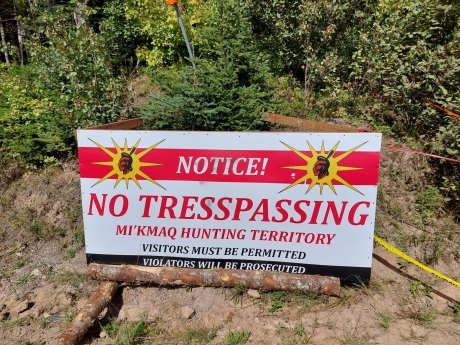
On Sept 4, Mi’kmaq people gathered at Tqamuoweye’katik (Hunter’s Mountain) on Unama’ki to block logging operations. Despite RCMP harassment, trucks were forced to drop their logs, leaving empty. Since then the camp has grown, and organizers have pledged to maintain it indefinitely.
Land and History
The Mi’kmaq people have thrived for at least 14,000 years on their traditional territory, Mi’kma’ki, which encompasses northern Maine, all of Nova Scotia, PEI, New Brunswick and parts of Newfoundland.
British and French forces clashed in a fight to control fishing in the region, and the British pushed the French out of the land that became mainland Nova Scotia before 1720.
To placate the large Mi’kmaq population and to draw them away from siding with the French, Britain signed peace and friendship treaties with the Mi’kmaq between 1725 and 1779.
After they defeated the French, the British increased settlement, disregarding the treaties, to control fishing, logging, farming and mining resources.
The Mi'kmaq people never ceded their land, retaining hunting, fishing and trapping rights - the treaties rather showed their willingness to share the land with others who would respect and steward it.
Various court cases affirm the existence (if not the appropriate extent) of Mi’kmaq rights – for example, the Donald Marshal supreme court decision in 1999 that affirmed that Mi'kmaq fishers had the right to fish "for a moderate livelihood".
Over the past decade, LNG projects had been defeated by the establishment of Mi'kmaq encampments on the land to block developments.
Tory government attacks and resistance
But now the Tory Provincial government is ramping up the attacks. In response to Trump, they passed Bill 6 lifting the longstanding moratorium of uranium mining and LNG development
In this very dry summer, fire and woods bans were instituted, with $25,000 fines for violators. Outrageously, these bans were not applied to clear-cut logging and mining on sensitive lands, including traditional hunting territories on Unama’ki (Cape Breton).
In late August, Ashton Bernard from Eskasoni Mi’kmaq Nation issued a call for Mi’kmaq people and allies to “rise together in unity for the protection of our lands, waters, animals, plants, and sacred resources.”
On Sept 4, Mi’kmaq people gathered at Tqamuoweye’katik (Hunter’s Mountain) on Unama’ki to block logging operations. Despite RCMP harassment, trucks were forced to drop their logs, leaving empty. Since then the camp has grown, and organizers have pledged to maintain it indefinitely.
On September 17th the Hunter’s Mountain camp released a remarkable public statement appealing for broader Mi’kmaq and settler support for the camp. The statement includes:
- An assertion of the collective rights of the Mi’kmaq gathering on the logging road to make their own decisions, rejecting external representation, including band council leaders
- A call for an immediate halt to all destructive development on Hunter’s Mountain
- A call for land recovery and stewardship with grassroots Mi’kmaq conservation and patrol teams managing resources and the land
- A call for energy and resource companies to pay back Mi’kmaq people for the destruction to their lands and for convictions of land defenders to be overturned
- A call for recognition of Mi'kmaq land title over Hunter’s Mountain
- Mandatory grade school education on Mi’kmaq sovereignty and rights
Shamefully, Premier Houston’s government has doubled down on attacks.
On September 23rd, they introduced Omnibus bill 127 (the “Protecting Nova Scotians Act”), including amendments to the Crown Lands Act, imposing $50,000 fines and/or six month sentences for those who ignore removal orders.
This bill was quickly pushed through to second reading, despite widespread outcry and public hearings were held on September 29th.
Michelle Paul, a Mi’kmaq water protector and land defender, told the hearings that the bill must be withdrawn, calling the lack of treaty recognition a “serious legal and moral omission”:
“It’s not lost upon us that this bill is being rushed through on the eve of Treaty Day and the National Day for Truth and Reconciliation. This government has shown a disregard and a lack of respect to push this through during this time.”
Ongoing Settler Colonialism
The government shamefully posted on social media on September 30th (Truth and Reconciliation Day) that it was a day “for Canadians to acknowledge and reflect on the legacy of residential schools”, while simultaneously continuing their legacy by criminalizing Mi’kmaq land defenders and water protectors.
October 1st is Treaty Day in Nova Scotia. According to the government post: “Today we honour the Peace and Friendship Treaties that shape our shared responsibilities. Treaties are not relics of the past — they are commitments to respect, partnership and ongoing dialogue.” These fine words were completely negated by the government’s actions. Settler colonialism is a “relic of the past” that must be overcome.
And on October 4th, the National Day for Action on Missing and Murdered Indigenous Women, Girls and Two-Spirit People, the government said nothing. Indigenous nations across Turtle Island rallied and marched for the implementation of the MMIW Inquiry recommendations. A decade later, almost nothing has been done.
This disrespect has fueled the resistance from the grassroots that in turn has spurred the Assembly of Nova Scotia Mi’kmaw Chiefs to criticize the bill, saying “This should be a time for greater trust-building with the Mi’kmaq, not escalating tensions and aggressive enforcement action.”
Tuma Wilson, who is a Mi’kmaq professor of politics at Acadia University who has been active at the Hunter’s Mountain camp, said Mi’kmaq have an inherent right to be on the land: “If anything, the Crown Lands Act should be amended to reflect the fact that it is our land and that we work in tandem with you to protect it.”
Build the resistance
But the government wasn’t listening, and the bill became law on Oct 3rd. Nevertheless, the Mi’kmaq gathered at Hunter’s Mountain are determined to keep fighting, and are working to mobilize broader layers of Mi’kmaq people to support the camp. There are legal challenges being planned, but maintaining the camp is the key. To do this, they will need all the solidarity they can get to build the broad fightback that can win.
In Quebec, Loi 97, that sought to “fast track” logging on Indigenous lands, was withdrawn by the CAQ government in late September because of broad resistance led by the MAMO alliance of Atikamekw, Innu and Abenaki peoples (“Mamo” means “together” in both the Innu and Atikamekw languages). Rail and road blockades and demonstrations in cities created enough pressure for the government to back down. This shows that united Mi’kmaq struggle can lead a broader fightback.
Stand with the Mi’kmaq people as they face off against the disrespectful and destructive Nova Scotia government. Show up in solidarity at the camp, just off the Cabot Trail, if you can. Join solidarity actions when they happen everywhere.
Supporters can e-transfer funds to micmacrights@gmail.com
Follow developments on www.micmacrights.com
Section:


Featured Event

Events
-
October 18, 2026TkarantoOrganized by:International Socialists
-
October 18, 2026TorontoOrganized by:International Socialists
Recent Videos


Visit our YouTube Channel for more videos:

Visit our UStream Channel for live videos: