|
Reports
You are here
Exposing right-wing forces behind Mexico's "Gen Z" protest
November 24, 2025
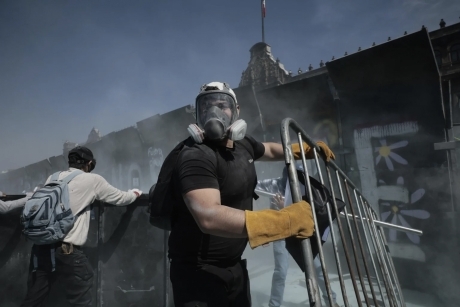
On November 15th (15N), a protest and riot in Mexico City received world-wide coverage, which claimed it was "organized primarily by Gen Z youth groups". But the protest was not a genuine youth movement, nor did it arise from indignation by the so-called Generation Z.
It was a coordinated operation, financed by right-wing politicians, business interests, and media figures from national and international circles. Far from being a Mexican youth movement, it was publicized through an account linked to international right-wing networks and their bots.
On October 3rd, Azteca News published a report portraying global youth protests, focusing on Carlos Bello, an influencer with no political background who suddenly appeared criticizing the government.
On October 7th, Ricardo Salinas Pliego, owner of TV Azteca and one of the main business opponents of the "Fourth Transformation" or 4T (the platform of the ruling Morena party inaugurated by former president Andrés Manuel López Obrador declaring that neoliberalism in Mexico would no longer guide the country’s economic policy) shared this influencer's video – a youthful image for a political narrative.
On October 12th, this influencer announced that a march was being organized – a march with no clear purpose, date, or demands.
On October 15th, the account GeneracionZ_mx uploaded an image with the "One Piece" flag, a symbol that has been used in youth protests in other countries. However, the account is not organic. Created in 2024, it was inactive for a year and previously amplified anti-leftist messages in Venezuela, Ecuador, and throughout Latin America.
On October 16, the right-wing account “Mexican Revolutionaries” appeared, releasing 10 AI-powered videos calling for a march for “recall of President Claudia Sheinbaum".
They began promoting the issue on October 26th. Of those 359 communities, 28 had foreign administrators, accounts focused on travel, makeup, memes, anime, video games, cooking, and tourism. Suddenly, they all started posting against the Fourth Transformation and in favor of this artificial march. The communities weren't created organically; they were rented, their audiences bought.
This isn't youth organizing – it's paid political marketing. From October 16th to 26th, the discourse was "peaceful march and recall referendum," but on October 25th, pages and accounts simultaneously began disseminating AI-generated images of the National Palace of Mexico on fire – a symbolic provocation.
And then, after the murder of Uruapan mayor Carlos Manzo, the entire network changed its narrative. What was a march for a recall referendum suddenly became a march against insecurity. This was a coordinated narrative shift, typical of structured digital campaigns.
On November 1st, Ivan Mero, the original creator of the digital community, publicly denounced that the GenerationZ version that organized the march was not his. He denied any ties to the right-wing PAN and PRI parties. On October 2nd and 3rd, he organized a march separate from the one on November 15th, calling it the first official mobilization. This shows that the November 15th march was not organized by young people but rather hijacked by political networks.
Members of the PAN and PRI parties, former presidents, and right-wing spokespeople began to amplify the march. Vicente Fox, Carlos González, Alessandra Rojo de la Vega, and PAN influencers were among those who participated, and even the use of the youth flag by PRI legislator Carlos Gutiérrez Mancilla was documented.
Here, the politicians arrived first and then sought out the young people. Salinas Pliego promotes the movement's first influencer; his media company amplifies the content, and his cousin Roberto Salinas, who directs Atlas Network, uses this international network of right-wing think tanks that has operated against progressive governments in Peru, Bolivia, Argentina, Brazil, and Mexico.
Added to this is Spanish media entrepreneur Javier Negre, who was invited to the country by Ricardo Salinas, and Fernando Cerimedo, a digital operative for Argentina's far-right President Javier Milei and Brazil's Jair Bolsonaro, an expert in bots and disinformation. Agustín Antonetti of the Libertad Foundation (Argentina), a promoter of anti-leftist narratives who is obsessed with anti-communism, and Eduardo Menoni, a far-right, anti-leftist Venezuelan activist with a network in Miami, are also involved.
The November 15th (15N) march was not local, youth-led, or spontaneous. It was not born on TikTok or Discord, and did not arise from the genuine disenchantment of a generation. It is part of an international strategy of destabilization targeting progressive governments. Independent analysts estimate that in October and the first days of November, the cost of this operation exceeded 90 million Mexican pesos (~5 million USD). Everything — the sudden activation of hundreds of accounts and the massive use of AI, the purchase of entire communities, the coordinated activation of influencers, the synchronized narrative — is a political operation designed, financed, and amplified by national and international right-wing networks seeking to disguise itself as a citizen movement using youth symbols, hired influencers, AI, and the purchase of digital farms.
It is a mobilization that aims to destabilize, manipulate emotions, and generate an artificial perception and images of violence. The data debunks this narrative, and the evidence that the artificial November 15th march was manufactured, and the movement was not youthful nor spontaneous. Some protesters were reportedly forced by their bosses to attend the rally or be fired.
The right-wing forces behind the November 15th protest are furious that the reformist Morena government continues to enjoy strong public support. But Sheinbaum is facing growing calls to implement a 40-hour work week, pitting Mexico's labour movement against both employer resistance and her government's stalling. In the period ahead, this working-class movement will be key as the US increasingly threatens direct intervention in Mexico.
With thanks to Carlos Vijnovsky Zenteno - Mexican Political Scientist and Public Administrator from Universidad Nacional Autónoma de México @UNAM_MX and Editorial Director of @ElSoberanoMX
Section:
Topics:


Featured Event
Events
-
October 18, 2026TkarantoOrganized by:International Socialists
-
October 18, 2026TorontoOrganized by:International Socialists
Recent Videos


Visit our YouTube Channel for more videos:

Visit our UStream Channel for live videos: