|
Columns
You are here
Nightmares and Dreams of Iranian Republicanism: The Responsibility of Intellectuals
January 22, 2026
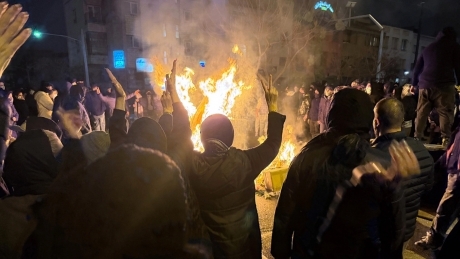
The following is an account of an Iranian student at Western University reflecting on the current protestsin Iran and its promises and dangers.
The situation in Iran is so dark and stark that it leaves anyone too overwhelmed for sober and comprehensive analysis.
It is important, however, not to fall for a simplifying framing that distorts the picture into a mere battle between the so-called brutal medieval mindset of political Islam against the secular mentality of modern Iranians. This framing is based on Orientalism, cultural essentialism, and dissociating cultural and political conflicts from the history of class and economic development in Iran. Mainstream media gives this framing.
By abandoning this framing, we can begin to look carefully at historical details and develop a better grasp of our situation. Understanding the situation clearly is essential for anyone who deeply cares about the sufferings of the people of Iran, wants to express solidarity, and intervene in a helpful way.
I intend to sketch or list my observations, striving to give clarity and a better understanding in these horrifying times.
The contradictions of Iran’s government
The Islamic Republic has brewed the wildest forms of capitalism and corrupt oligarchy in an economy that has been under severe illegal and geopolitically driven sanctions by the West. Instead of an economy adapted to the sanctions, Iran's economy has been adapted to the greed of its capitalist elite. This economic policy has pushed the republican interpretation of Islam, moulded in the dawn of the 1979-80 revolution, toward a dictatorial version of Islam that is hollowed out, deprived of popular anti-colonialism, and devoid of support of the masses of the poor.
Now, the evolved version of Iranian Islamic republicanism is an exclusive identity politics. It takes pride in estranging the “impious” lifestyle of the modern urbanized middle class. It emphasizes the lifestyle and dressing of women over a political agenda to keep the nation united under the constant threat of imperialist bullying.
There is no inherent essence to Islam (or Christianity, or any other religion) that requires it to only be enacted in progressive or reactionary ways. It is individuals who interpret and reproduce the religion in ways that reflect their historical and economic situations. Shia Islam, as interpreted by the founders of the Islamic Republic, has exhausted its potential as a language for oppressed, anti-colonial, third-world revolutionary populism. It has shown that it cannot evolve and be flexible to changing realities.
It constantly brings itself to the verge of contradiction. Privatization and wild capitalism oppress workers within Iran, while the government resists full subordination to the imperial West’s global poles of capitalism.
Republicanism in Iran
The modern political culture in Iran, which emerged during Iran's constitutional revolution of 1905-1911, has been historically steered by the European style of republicanism. Republicanism in 19th century waves of European revolutions acted as a cultural format for political movements of the time. As a language of revolutionary politics, it contrasts with more “tolerant” political ideologies like liberalism. It invokes big ideas like equality, liberty, and national and civic virtues to set the political agenda for movements and justifications for political institutions and arguments. The Republican spirit allows for the state to pursue some idea of civic virtues and moral perfection upheld by the population, as opposed to the liberal notion of an anti-perfectionist state, which supposedly avoids advocating any vision of a good life and civic virtues for individuals.
Since its birth, Iran's political culture evolved in a republican way. The populist political format appealing to the oppressed masses was always an inevitable part of the picture. A vision of a “good” Iranian life - religious or secular (whether the secular vision was a nationalist or socialist one)- was central to its political development. Under the threat of colonialism, foreign capital and states, a Middle Eastern modern political culture could not afford too much tolerance.
Islamic Republicanism was the synthesis and the outcome of decades of Iranian modernization, from its constitutional revolution in 1906 to its anti-monarchist revolution of 1979. Seven decades of political development pushed away secular republicanism - nationalist or leftist - and landed the victory card in the hands of Islamic Republicanism.
The main reason for this was not only the activities of the Islamist intelligentsia, but also the US and the Pahlavi monarchy's repression and coups against secular republicanism.
Two equally despicable options for Iranians
The political mentality of Iranians is torn between two equally despicable options: 1) giving up on their republican dreams of national autonomy by submitting to US imperialism; or 2) not giving up and tolerating the existing Islamic Republic.
Beneath the first option, Iran would be deprived of its independence and subsumed under US imperialism as a client state that, like most US client states, only affords false democracy. It would give up sovereignty over economic and national policies and play by the rules of imperialism. To give up on republicanism is to give up on the idea that Iranians could ever think for themselves. They should love Israel and the US, even if they don't want to, and if, for a second, they were tempted to sympathize with the victims of the US and Israel in the region - that is, if they ever wanted to act on their temptation of solidarity with Palestinians - as an independent, autonomous national policy, that would be considered misbehavior and would not be tolerated by the Imperialist Masters of the Middle East.
In the case of foreign intervention, Iran would not face a mild loss of self-autonomy in exchange for mercy from the political-economic elite of the West. The Iranian society would face total destruction. This ranges from civil war - the Balkanization of Iran - to the installation of a brutal dictator who makes sure Iranian political consciousness will never dream again of republicanism and independence, or that gives the West full license to plunder Iranian resources. The “stable option” in Iran - that would keep the foreign powers, the domestic capitalists, and the elites happy - would be a brutal option.
Beneath the second option, Iran would remain suffocated by the Islamic Republic, which has inflexibly and dogmatically stuck to its exclusive version of Islam, its neoliberal capitalism, and its desperate under-preparation in the face of Western threat and sanctions. This will not do. The ordinary people will not stay within a system that is fully dysfunctional and has developed its internal contradictions to the tipping point of undermining itself.
What the Iranians collectively choose as their future is beyond the control of anyone. Whether Iranians will choose their future with self-awareness of its history, economic, and geopolitical situation is still up for debate. It is imperative to reframe the political imagination from this false dichotomy between two evils and think of a third way where political action and movement arise from organized popular power and political awareness, and not desperation. The Workers’ Union of Tehran and Suburbs Bus Company statementis a bright example of working toward a third way.
Lazy Revolutionaries: Politics of desperation and impulsivity
The politics of the Iranian middle-class diaspora could be characterized as a politics of lazy revolutionaries. Their implicit but commonly accepted idea is to outsource the “revolution” to Israel, the US, and the violent extremist wing of organized monarchists funded by foreign lobbies.
It is almost a truism that you cannot bomb your way into democracy and freedom, especially in the Middle East, especially if the bombs are Israeli and American. A slight glance into historical records substantiates that truism.
For one to cook up such an illusion about shortcuts and outsourcing, one has to be really lazy, intellectually and morally; detached from reality and history; and manipulated to the extent that politics will appear as an irresponsible, impulsive behaviour. One has to cry: “I hate this, I love this, let’s follow that demagogue."
In this regard, the so-called MAGA and monarchist MIGA (Make Iran Great Again) movement truly belong to the same category, both detached from reality, both guided by mythology, irrationalism, and anti-intellectualism.
This laziness is rooted in different factors. First, the Iranian government has restricted the political arena to its elite, has favoured circles, and has depoliticized a good chunk of the population of the middle and working classes. Additionally, neoliberalized education and the precarious job market have made it a luxury for ordinary people to pay attention to politics and history. The middle classes, in the absence of an organized progressive working class alternative, tend to turn to right-wing ideas and become a fertile ground for the rise of fascist and racist ideas. It is hard to produce intellectual ideas, publications, and poetry, and any resemblance to rational discourse if you are on the side of apartheid, genocide, and imperialism.
Monarchists, like most fascist movements in history, try to capitalize on the desperation and impulsivity of the Iranian masses. Still, that is not the whole story. They have gone even a step further: they have made an unquestioned assumption that there is no need to go through the demanding labor of doing politics (even based on impulsivity). Rather, “revolution” can be outsourced to a butcher who is still not done with the ongoing genocidein Palestine.
An alternative might be to consider mass-based organizations and party publications with media and intellectuals. Building mass-based parties has remarkable examples in the history of modern Iran. In a short window of democratic opportunity after the fall of the tyrannical rule of the first Pahlavi till the US-backed coup and restoration of the tyrannical monarchy of the second Pahlavi (1941-1953), we had mass parties like the National Front, the Tudeh Party, Iran Party, National Will Party, and a dozen more parties ranging from right to left.
The Tudeh party, while banned and working underground, had a remarkable role in the movement of oil nationalization by organizing its supporters among the urban middle-class and workers and holding demonstrations all over Iran. Meanwhile, 80% of the conservative and monarchist parties in the Iranian parliament were on the CIA payroll. There was no shortcut to winning the support of the masses in such a critical time in Iran’s history. (See Abrahamian, Iran between two revolutions, Ch 5)
The responsibility of intellectuals
Fighting capitalism, fascism, and imperialism is a boring, long-term repetitive task and not a series of heroic short-term acts. Just like in a human relationship, where we need healthy, boring communication about laundry folding, house chores, and silly mistakes, intellectuals must take on the constant, boring tasks of going through history.
This includes going through the details of the 1953 coup and the constitutional revolution against the right-wing and monarchist interpretation of it. This includes laboring over the details of specific economic, banking, and trade policies of the government. This includes helping people distinguish the real roots of their misery from what they are led to believe by propagandafrom those in power.
The situation, surely, is dire enough, but not hopeless. The responsibility of progressive and left intellectuals, inside or outside Iran, is structurally like that of a therapist: They should not tell people what they want, or what they should “really want”. Instead, they should act as a reality check and a memory of the people and the protesters. They should help people sculpt their distorted consciousness into a coherent one, and then the choice will be clear for them by their own deliberation.
Section:


Featured Event

Events
-
October 18, 2026TkarantoOrganized by:International Socialists
-
October 18, 2026TorontoOrganized by:International Socialists
Recent Videos


Visit our YouTube Channel for more videos:

Visit our UStream Channel for live videos: