|
Arts
You are here
Persian calligraphy and womanhood in Iran
January 30, 2026
Exhibit review - Grounding: States of Gender
Persian calligraphy and womanhood in Iran
“What are the ways in which gender has actually conditioned our life?” asked Iranian artist Gita Hashemi, introducing Grounding: States of Gender at Western University’s John Labatt Visual Arts Centre on January 8. Curated by Soheila Esfahani, the exhibit was displayed at the artLAB Gallery.
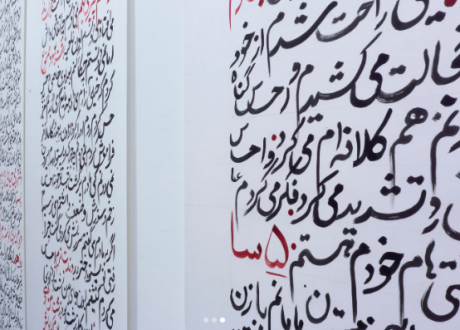
Grounding features Persian calligraphy that tells the story of a woman in Tehran named Zahra. The swaying script is written on twenty-two scrolls that cover the gallery walls, circling audiences from all sides. Live-streamed footage of Hashemi writing the calligraphy — on hands and knees, with ink and paintbrush, the letters curling, flaring, flowing — is projected on the gallery floor. Evocative audio blares in the gallery: air-splitting ululations that mark “when the female voice becomes public”, a rush of men’s voices, women’s haunting and insistent whispers.
The words in the calligraphy are Zahra’s. They emerged through months of email correspondences with Hashemi where Zahra wrote about memories that mark her reflections on womanhood. Their discussions were intimate, revealing, and healing.
“We had to think about feeling — what is that feeling of childhood? — and visit all of the difficult and traumatic memories that are necessary,” said Hashemi. “What you see here is a documentation of that conversation.
”
Zahra’s writing is raw. It documents graphic physical violence, harsh isolation, a fracturing self, cycles of tenderness sought and denied. Her body is explained as a site of carnal curiosity, fear, and submission. Her life — school, family, lovers, interrogation during the Iranian Cultural Revolution of the 1980s — is articulated through the lens of how gender has stalked her psyche.
Universal experience
Says Hashemi: “States of Gender, for me, points to the fact that, although [gender] is assigned, it is also in flux and can go through different states. At the same time, ‘states’ evokes the involvement of political systems in the experience of gender. The title points to the foundational role of gender, which is itself a construct, in the construction of our identity, socio-economic status, and life experiences.”
Hashemi emphasizes the universality of Grounding. Though recounting the story of an Iranian woman, the concept of the performance arose as Hashemi contemplated the subjugation of women across the world.
“There is the man who is now president [Trump] saying “grab [women] by the pussy. There is the campus rapist walking free, and the radio host acquitted of sexual assault. There was Pussy Riot in Russia, masses of women in rallies against rape in India, and Women’s March on Washington. There is the Islamic State, and here, in the “West” is the state of poverty that increasing numbers of women are pushed into, courtesy of neo-liberalism and politics of austerity,” writes Hashemi.
“Wherever we are located geo-politically, gender writes us. Gender writes on the body. It is the most pervasive marker of the individual and the social body. It defines us in the most intimate ways and in the most intimate spaces. It conditions our interaction with the world and our place and power within it. In a gendered state, there is nothing neutral about gender, nothing given, nothing natural.”
Gendered calligraphy
Hashemi explained that transcribing Zahra’s story in Persian calligraphy, on wall-sized parchment, resists convention. She described Persian calligraphy as a revered part of Iranian culture that has been dominated by men; the language is formal, focused on poetry, sacred texts, and sealed within manuscripts.
Zahra’s story — written by a woman, calligraphed by a woman, in language that is colloquial, intimate, and profane, with lettering amplified to public monumental scale — breaks these norms. It practices a bold equality of form, craft, and content. With this delivery, a voice that has been silenced rises.
In traditional calligraphy, black ink is used for the main text while red ink might signify chapter titles or opening words. As Hashemi transcribed, she shifted from black to red ink when she read parts of Zahra’s story that viscerally marked her.
Livestream
Hashemi said it was crucial to livestream her transcribing of Zahra’s story. It ensured that the story was witnessed as it was created, synchronizing audiences to the labor of delivering Zahra’s narrative. And it ensured it cannot be taken back or censored in any way.
The original livestream was created over eight days at Carleton University. Hashemi didn’t have Zahra’s full text when she began transcribing; their correspondences were ongoing, and Hashemi transcribed new text almost as it came.
Two scrolls in the exhibit remain blank. They signify that other stories are yet to be written, and that Zahra’s story is not fully contained in Grounding — it precedes and outlives the performance.
Translation
For non-Farsi speakers, English translations of Zahra’s story are printed in folders, translated by Hashemi and her collaborators. They lie in the gallery’s alcove on a small table surrounded by cushions. Hashemi refrained from providing English translations in the performance itself.
“This work could only be done in Persian and could not be subtitled in English because I think it's important that the specific content should not be translated for consumption. You need to do some labour to access it…Obviously, many culturally specific things remain opaque. That's okay. As an audience, we need to get used to the discomfort of not getting it all. It's a colonial impulse to expect that we can look at something that is culturally remote from us and fully occupy it.”
Context of dissent and resistance
Grounding was completed in 2017. The #MeToo movement and #WomanLifeFreedom protests in Iran followed, a trail of dissenting stories echoing the harshness in Zahra’s. Today, Hashemi feels a tie between her work, current protests in Iran, and ongoing genocide in Palestine. She wore a black keffiyeh to the exhibit’s opening night at Western University’s gallery.
“I am standing here fully aware that today and in the past few weeks there have been more protests in Iran. And I want to acknowledge that today is day 826 of Israel’s genocide in Palestine and year 77 of the occupation. As a minority, as a racialized person, an Iranian, I am very aware of the fact that any work that I do as an artist carries that history of colonization, trauma, political turmoil.”
Hashemi penned a letter addressed to “Canadians of Conscience” open for signing that describes Iran’s cyclical history of revolutions and how to take action in the current moment. She writes:
“We must demand that Canada end debilitating economic sanctions against Iran that have created rampant black markets for necessities of life. We must firmly stand against the brutality of the IRI against Iranians. We must speak out against the US agenda of regime change and the threats of military intervention. We must refuse to accept that the only choice for the Iranian people is between foreign occupation and iron fist repression.”
Iranian graduate student Ebrahim, who visited Grounding, speaks to the necessity of exhibits like this. They cause “disturbances” that awaken audiences to sociopolitical realities in the past and present. He gestures to a scroll, thinking of the current protests in Iran.
“I’m happy to read it, especially this part. It’s her experience of a prison, and what might happen in future for our people.”
Section:
Topics:


Featured Event
Events
-
October 18, 2026TkarantoOrganized by:International Socialists
-
October 18, 2026TorontoOrganized by:International Socialists
Recent Videos


Visit our YouTube Channel for more videos:

Visit our UStream Channel for live videos: