
|
Arts
You are here
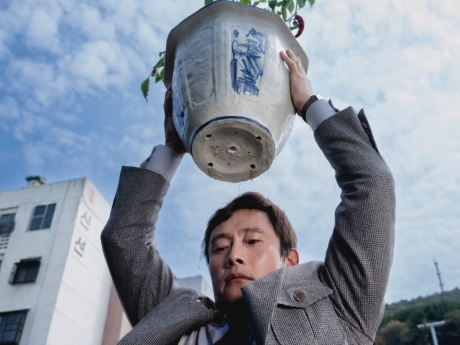
Movie review: No Other Choice
March 9, 2026
Directed by Park Chan-wook
No Other Choice is a movie for our times but may remind you of another film that also depicts the ravages of capitalism, more at the beginnings of automation and industrialization – Charlie Chaplin’s Modern Times.
Modern Times was released in 1936 when capitalism had entered a crisis from which fascism seemed like the logical conclusion. The famous scene of the little tramp getting caught in the cogs of the factorymachinery is an apt comparison to Chan-wook’s film.
The movie’s title is repeated at various points in the movie – first by the American executives who take over Solar Paper, a Korean company, where the protagonist, Man-su (Lee Byung Hun), a low-level manager who has given 25 years of his life to the company, is fired because he refuses to come up with a list of employees to be made redundant by the new owners.
He plans to make a heroic speech explaining to his new bosses why they shouldn’t let workers who have accumulated skills and shown loyalty to the paper company be thrown on the scrap heap. He barely gets out a few words before the American executives sweep by him into a waiting limo, muttering, ‘No other choice’.
Chan-wook’s movie shows us the way the economic system traps workers into ever narrowing possibilities if they want to survive. At the beginning of the movie, we’re presented with the American, or rather, Korean, dream – the family BBQ complete with happy couple, two children and two dogs. Man-su has been gifted eel from his bosses as a thank you for his service to the company, just shortly before he will be sacked.
Within six months they are in danger of losing their home, along with sacrificing Netflix (a loss which particularly upsets Man-su’s teenage step-son) and tennis lessons for Man-su’s wife Miri (Son Yejin). Their young daughter, who is a child prodigy on the cello and who speaks only to repeat phrases she has heard from others, needs to move to the next level of teaching to have any chance of reaching her potential and this now seems out of reach.
The brutality of the economic system is mirrored in the plan Man-su devises to get back his former life. It involves subterfuge and violence, taking out the two main rivals for a new manager’s job at another paper company. Chan-wook plays this partially for comedy, as Korean filmmaker Bong Joon-Ho often does in his films, despite the grim nature of their subject matter, depicting as they do the gap between the super wealthy and the rest of us and the violence of an economic system that creates and perpetuates these gross inequalities and which turns those on the sharp end of capitalism against each other, rather than against the system.
Lee Byung Hun, the actor who plays Man-su, is powerful in this role, as he believably expresses both tenderness and rage. People may recognize him from the Netflix series Squid Game, which similarly lampoons the violence of the economic system. It seems not so surprising that a country like South Korea, which fought tooth and nail to become a middle capitalist power, one of the Asian tigers, did so only with immense sacrifice on the part of ordinary workers. The rise of Korean capitalism, as in every other industrial nation, succeeded on the backs of labour, which is then sacrificed when capitalism stumbles.
There is comedy in Chan-wook’s movie, but it is a savage humour, similar to what we saw in Bong Joon Ho’s masterpiece Parasite. If the movie can be generally described as a black comedy it also packs a gut punch in its final vision of a newly reconstituted workplace where workers are largely absent, except for Man-su, who supervises alone in an empty factory floor as AI and machines operate in a largely human-free environment.
Chan-wook dedicated his movie to Costa-Gavras, the Greek-French master of political cinema. Costa-Gavras made his film Le Couperet (The Axe), as did Chan-wook, based on a 1997 novel “The Ax” by American writer Donald E. Westlake. All of this to say that the story of capitalism and the way it treats workers, the people who create all wealth through their labour, is strikingly transposable from one country to another.
Section:
Topics:


Featured Event
Events
-
October 18, 2026TkarantoOrganized by:International Socialists
-
October 18, 2026TorontoOrganized by:International Socialists
Recent Videos


Visit our YouTube Channel for more videos:

Visit our UStream Channel for live videos: