|
Features
You are here
War on Iran exposes US weakness
April 10, 2026
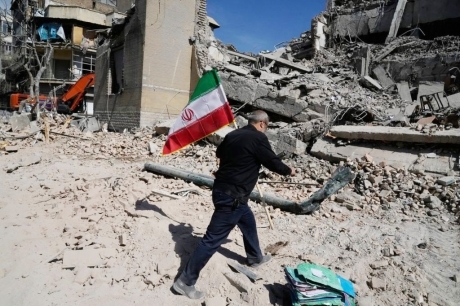
The two-week ceasefire announced on April 7 is precarious and the 10-point settlement plan drafted by Iran has already been violated. Negotiations are just now starting in Islamabad to try and end to the war.
But one thing has become very clear amid the chaotic scene: the US could not impose its will on Iran despite the genocidal threats from Donald Trump. In other words, the US failed to turn its threats into command.
For 40 days, the US and Israelis launched assault after assault on Iran, promising decisive results, threatening annihilation, and signalling that Iran could be broken militarily and politically in short order. What the US got instead was non-stop retaliation by Iran against US bases in the Gulf, a military capability that badly damaged two US aircraft carriers, symbols of US dominance since WWII, and the closure of the crucial Strait of Hormuz, with lasting economic impact on the world economy.
With this war, American domination over West Asia has entered a definitive crisis, exposing the weakening grip of US hegemony. If the war is over, and no one should count on that yet, Iran has emerged politically strengthened by surviving two massive bombing campaigns by the US and Israel in the last year. The Islamic Republic remains in power, much of the Revolutionary Guard apparatus is intact, Iran retains leverage over Hormuz, and it has entered negotiations without capitulating. The ceasefire therefore marks a political setback for US imperialism.
This war has to be situated within the already ongoing relative decline of US power. The productive foundations of American hegemony have been hollowed out for decades, especially in relation to China. In 1945, the US accounted for roughly half of world manufacturing output. By 2024, China produced close to 30 percent of global manufacturing value added, while the US accounted for only about 10 percent. That decline is now expressing itself in military and geopolitical form.
China’s reliance on Iranian fossil fuels has long made Iran a target in wider US strategy. US war hawks have wanted an attack on Iran for decades as a way to weaken the Chinese economy. Yet, these ambitions were repeatedly checked by planners in the Pentagon, who understood the scale of the risk. Iran is far larger and more militarily capable than the targets of previous US wars. It has advanced missile and drone capacity, almost one million soldiers, and difficult geography, surrounded by mountains and protected by terrain that makes invasion extraordinarily costly. Despite the onslaught, Iran has retained substantial military capacity.
The US military has long functioned as the armed enforcer of global capitalism, policing sea lanes and strategic regions through naval and air supremacy. Iran has shown that it can disrupt one of the most strategic chokepoints in the world economy, the Strait of Hormuz, and force the US to bargain without having first secured decisive victory. Even after the ceasefire, only a handful of vessels have passed through Hormuz, hundreds remain stranded, and Iran is still effectively controlling access.
Hormuz is a crucial artery for oil (12.5 million barrels a day), gas (11.5 billion cubic metres of natural gas), and fertilizer flows, and US military power has failed to secure the infrastructures that underpin its wider system of domination despite its destructive capacity.
The aging US war machine
The war has also exposed the weakness of the aging US war machine. The military-industrial complex remains gigantic, but it is bloated and wasteful. The decline in US manufacturing capacity was sharpened by the organisation of capitalist production itself. In 1990, the US had 51 suppliers of major military hardware. Today, that number has shrunk to five giants: Lockheed Martin, RTX, General Dynamics, Northrop Grumman, and Boeing. This concentration reflects decades of mergers and acquisitions, resulting in a dramatic reduction in the workforce in war industries, from around 3 million workers to a little over 1 million today. At the same time, the Pentagon has failed seven audits in a row, with trillions of dollars unaccounted for. Profit, waste, and lack of scrutiny have undermined the very base of US military power despite the enormous size of the defence budget, which is more than the combined defence expenditures of the ten countries following the US.
When China held a military parade last year, analysts were struck by both the sophistication of the weapons on display and the manufacturing capacity behind them. Those displays likely did not even include China’s most advanced systems. By contrast, the US military-industrial complex is corrupt and increasingly incapable of meeting the demands of a prolonged conflict. The US and its allies were spending an average of $5 million on an interceptor missile to shoot down Iranian drones, each of which cost around $20,000.
This inability to project uncontested power will have significant consequences for US-Gulf state relations. Gulf states have long depended on US security guarantees while using petrodollar wealth to expand their regional and global reach. Those guarantees now lie in tatters. For states such as the UAE and Saudi Arabia, which had jumped on Trump’s so-called Board of Peace after Israel’s genocidal wars in expectation of new profits, the illusion of order has been demolished. Gulf rulers are considering new alignments, as the US has shown that it cannot simply stabilize the region by force. They are now orienting themselves toward negotiation and hedging by striking bilateral deals with Iran. Qatar and Oman agreed to pay Iran for safe passage through Hormuz using the Chinese yuan, a move that further weakened US control over global payment systems.
Given that US hegemony today rests far less on productive supremacy than on financial domination, with the dollar as the world’s main reserve currency since 1973, the more the petrodollar system comes under strain and the more trade shifts into other currencies, the more the military and financial pillars of US hegemony begin to erode together.
The Israeli plan
Israel has used the fog of war to drive forward its own expansionist project. While continuing the genocide in Gaza and its attacks on the West Bank, Israel waged a renewed war on Lebanon.
Even after the two-week ceasefire was agreed, whose foundational 10-point plan stipulated an end to the war on Lebanon, Israel’s answer was escalation, targeting central Beirut and killing more than 300 people in a day. Israel’s invasive campaign did not produce a victory in 2006 and will not produce one in 2026. Although Israel wants to preserve its freedom to commit genocide and expand its aggression in Lebanon and elsewhere, it has received a huge blow in this war by failing to keep the US, its major endorser and sponsor, in a state of permanent war in the Middle East.
In the coming months and years, it will be crucial to campaign to sever the ties between all the imperialist powers and Israel to stop its strategy of regional domination. Since October 7, 2023, the far right inside Israel has not simply remained in government, but its ideas have become more deeply embedded in public life. The Israeli state is pursuing a maximalist project of territorial seizure, genocidal violence, and permanent war. We have to continue to fight against genocide in Gaza and Palestinian liberation.
However, this Israeli aggression is also meeting another force. In the two and a half years since the genocide in Gaza began, global public opinion has shifted sharply against Israel. In the US, recent polls show that among young people, support for Zionism now sits at only 15 to 17 percent. This helps explain the limited support within the US population for a war with Iran. The external limits of US hegemony are now colliding with internal anger over genocide, war spending, paramilitary repression over immigrants through ICE, and the increasing authoritarianism under Trump. Recent mobilisations in the US, the UK, Italy, Greece, and partly in Canada suggest that anti-war sentiments are increasingly merging with opposition to the far right and to the cost of living crisis exacerbated by the war.
Global struggle against war, austerity and far-right
The economic consequences of this war will be borne by workers. Inflationary pressures caused by rising oil, gas, and food prices will spread. We hear from the Canadian government that we must accept austerity and service cuts in the name of security. We should not forget that the bill for war is always paid by ordinary people. That means the anti-war movement has to connect imperialist violence abroad to class struggle at home. So the slogan of the working class across the world must be the same: we will not pay for the war.
The relative decline of the US and the collapse of support for the US-Israeli wars do not make the world safer automatically. A declining empire remains immensely dangerous. In addition, inter-imperialist rivalry is likely to adjust itself to the relative decline of US power, which might involve more widespread conflict in different geo-strategic regions of the world.
Our task in this period therefore goes beyond observing imperial decline and requires organising mass working class resistance against the monsters of militarization and austerity that this world-historic transformation unleashes.
Section:
Topics:


Featured Event

Events
-
October 18, 2026TkarantoOrganized by:International Socialists
-
October 18, 2026TorontoOrganized by:International Socialists
Recent Videos


Visit our YouTube Channel for more videos:

Visit our UStream Channel for live videos: