|
Reports
You are here
Premier Eby, hands off the Declaration on the Rights of Indigenous Peoples Act!
April 16, 2026
In the fall of 2019 the NDP government of BC passed the Declaration on the Rights of Indigenous Peoples Act (DRIPA). The act defines its purposes as follows,
(a) to affirm the application of the [UN] Declaration [on the Rights of Indigenous People] to the laws of British Columbia;
(b) to contribute to the implementation of the Declaration;
(c) to support the affirmation of, and develop relationships with, Indigenous governing bodies.
Over the last few months the NDP premier of BC, David Eby, has taken action against all three of those principals.
From dream to nightmare
In the fall of 2019, Scott Fraser who was the Minister of Indigenous Relations and Reconciliation spoke in the BC legislature, “Today I am proud to introduce Bill 41, the Declaration on the Rights of Indigenous Peoples Act. It’s like a dream. Our government is firmly committed to advancing reconciliation with Indigenous peoples in this province.” He went on to explain that the bill,”is a commitment to respect, promote and advance the rights of Indigenous peoples.“
After this introduction the legislation was officially in recess in order to allow Grand Chief Ed John, Cheryl Casimer, Regional Chief Terry Teegee, and Grand Chief Stewart Phillip and Premier John Horgan to address the MLAs.
Premier Horgan unknowingly foreshadowed the fate of the bill, “The road travelled to get here has been filled with confrontation, litigation and negotiation. History is littered with words that were not followed up with actions.”
Cheryl Casimer of the Ktunaxa Nation, reminded MLAs of the record of the province of BC, “The relationship between the Crown in Right of British Columbia and First Nations is one that has been mired in racism, denial and, therefore, conflict and adversity. The provincial government has a long history of denying the very existence of Indigenous peoples of this land and of our rights. This denial is reflected and deeply embedded in laws enacted by the government and the corresponding policies and practices in its daily business of the province. As a result, our relationship has developed primarily in the courts, where First Nations have sought to be recognized and to protect their rights by challenging these denial-based laws and policies.”
Government and Indigenous leaders commented warmly on the consultation and negotiations between them that went into creating this legislation. The act was passed unanimously in the BC Legislature.
Old habits
Since 2019 several nations have resorted to the courts once again because the NDP government will not recognize their rights. Over the last year two court decisions in favour of Indigenous land rights have scared resource industries in this province. And each time, Premier Eby has been quick to oppose Indigenous rights.
Last summer the longest trial in Canadian history wrapped up. Coincidentally, the trial started days before the Declaration Act was introduced in the legislature. The Quw’utsun (Cowichan) Nation had traveled from their lands on Vancouver island to their village of Tl’uqtinus in what is now Richmond BC every year since time immemorial until the 1860s. Then their land was sold, initially without their knowledge, after BC’s first Chief Commissioner of Lands and Works, Colonel Richard Moody, ignored orders to preserve it and instead sold it to himself. After a few years when it had increased in value, without Moody ever visiting the land, he sold it on for a profit.
The supreme court decided that selling stolen land doesn’t make it less stolen. The court ruled that the Quw’utsun Nationhave title to land “owned” by Canada and the city of Richmond. They also ruled that “BC owes a duty to the Cowichan to negotiate in good faith reconciliation” of the ownership of the land that has been sold to individuals and businesses. The Quw’utsun have been clear that they wanted negotiations instead of court case all along and are eager to negotiate with the province now. They have also been clear that “the Quw’utsun Nation’s court case regarding their settlement lands at Tl’uqtinus in Richmond has not and does not challenge the effectiveness or validity of any title held by individual private landowners.” They point out that, “Generations of real Quw’utsun people, including our current membership, were denied the ability to exercise our way of life, and access to key food and trade systems, when our settlement lands at Tl’uqtinus were taken from us. We continue to experience the impacts today. However, we are a respectful people. We intentionally did not bring this case against any individual private landowners, and we did not seek to invalidate any of their land titles. The decision makes it clear that it is B.C.’s obligation to advance reconciliation in these circumstances,” said Quw’utsun Nation Chief Cindy Daniels (Sulsulxumaat) of Cowichan Tribes.
Mired in racism
Premier Eby, “mired in racism” refused to negotiate and his government is appealing the case instead. He has repeated the racist talking points of the far-right in BC, “ “These are profound issues that are hard to consider in the absence of the real people … the homeowners, the business owners, who will be affected by this decision . . . I want the court to look into the eyes, metaphorically speaking, of the people who will be directly affected by this decision and understand the impact on certainty for business, for prosperity and for our negotiations with Indigenous people.” As the Union of BC Indian Chiefs pointed out, this amounts to considering the members of Quw’utsun nation as not “real people.” He is also playing on the unfounded fear that the Quw’utsun nation is trying to take away homes and businesses.
The second case where the Premier remains “mired in conflict and adversity,” was decided last December when the BC Court of Appeal ruled that the province’s mineral claims process was inconsistent with the UNDRIP because mineral claims can be made on Indigenous land not only without their consent but also without their knowledge. The court also ruled that UNDRIP is part of BC law and should be used to interpret those laws. A premier committed to reconciliation would welcome this decision and take this opportunity to patiently explain the notion of “free, prior and informed consent.” He would point out that amending the claims system in the Mineral Tenure Act has been a longstanding part of the Declaration Act action plan. Premier Eby instead announced that the province would appeal the decision and amend the Declaration Act to prevent Indigenous nations from forcing the province to amend this law and other BC laws that are in conflict with the UNDRIP. (Amending laws, as you may recall, is the purpose of the act in the first place.)
Instead of relying on negotiation and consultation with Indigenous leaders, Eby declared that amending the Declaration Act was non-negotiable. He claimed that the act had to be changed so that Indigenous Nations can not use lawsuits to force BC’s laws to comply with the Declaration on the Rights of Indigenous Peoples.
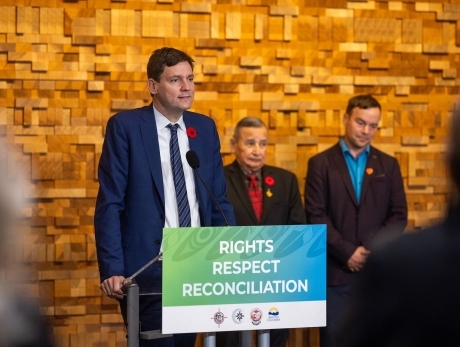
Ebby summoned Indigenous leaders to a meeting on April 2nd to tell them what unilateral changes he was going to make. ʔaʔsiwɬ Grand Chief Stewart Phillip and Union of BC Indian Chiefs President, was present when the Declaration Act was first introduced. He responded to Eby’s proposed changes, “We can't have the key Indigenous-specific piece of human rights legislation subject to cabinet will, when other human rights legislation is justiciable,”
Eby’s changes faced unanimous opposition from Indigenous organizations. A few days after he changed tack. Now he proposed that the act would not be amended, but instead suspended for three years. He made the vote to suspend the act a confidence motion that was supposed to be voted on on Monday April 13. CBC news reported that over the weekend, ten NDP MLAs refused to support this attack on Indigenous rights and Eby backed down again and did not introduce the suspension of the act to the legislature. He now says that there will be changes, or a suspension, or something, and it will be soon, but it won’t be a confidence motion.
Attacking the NDP’s own Declaration on the Rights of Indigenous Peoples Act is just the latest example of Premier Eby taking on the talking points and the platform of the BC Conservatives. Previously he ended BC’s limited drug decriminalization program without consulting or informing the Indigenous organizations that helped put it together. He has a plan to replace mental health care with prison time, and he wants to make it harder for people accused of crimes to access bail while waiting for a trial.
As is usual when a “progressive” party lurches to the right, the beneficiary is the right. As Eby succeeds in convincing people to oppose Indigenous rights, he is also convincing them to support the leaderless BC Conservative party.
A recent Angus Reid poll shows an increase in respondents who believe that the Declaration Act, “goes too far in limiting provincial authority over land and resources.” In March of last year 44% agreed with that statement, this March it has risen to 53%. Meanwhile, approval of Premier Eby has declined from its peak of 53% last March down to 37% now. The BC Conservatives now have 44% of decided voters vs the NDP’s 42%. Among those who believe that the Declaration Act goes too far, 70% would vote Conservative. The more success Eby has in convincing the people of BC to turn their back on reconciliation the better the chances are for a Conservative election win.
An injury to one is an injury to all
In a statement released on April 9, First Nations Leadership Council, FNLC, called “for the immediate withdrawal of any proposals to amend or suspend the Declaration Act or the Interpretation Act. If the government proceeds with any legislative proposal without the free, prior and informed consent of First Nations, the FNLC and First Nations will be forced to pursue every available avenue, legal, political and through direct action to defend First Nations’ rights.”
It is urgent that we act in solidarity with Indigenous nations and beat back the NDP attacks on the Declaration Act and we must make sure that the government is defeated in its attempts to reverse Indigenous land claims victories in the courts. Not only because this province and country was built on genocide and ethnic cleansing, as if that wasn’t enough. But if the NDP rolls back Indigenous rights and convinces more people of their racist arguments for doing so, they won’t stop there. Behind the NDP assault on Indigenous rights is their allegiance to resource industries. They are already attacking environmental regulations under the cover of fighting Trump. While the fracked gas industry enjoys billions in subsidies from the province our schools, hospitals and post-secondary systems are underfunded and failing. If Premier Eby’s racist arguments can distract people from the multiple crises caused by putting profit before people we will all lose.
Section:


Featured Event

Events
-
October 18, 2026TkarantoOrganized by:International Socialists
-
October 18, 2026TorontoOrganized by:International Socialists
Recent Videos


Visit our YouTube Channel for more videos:

Visit our UStream Channel for live videos: