
|
Reports
You are here
Toronto’s rideshare drivers rise as anti-Indian racism grows in Canada
May 6, 2026
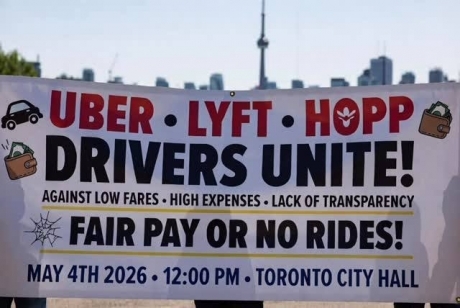
Rideshare drivers rallied outside Toronto City Hall on May 4, demanding an end to poverty wages and arbitrary treatment by platform companies. Targeting Uber, Lyft, and newer entrant Hopp, drivers called for the restoration of suspended accounts, payment for waiting time, transparency in fares and commissions, and an end to sudden deactivations without proper investigation.
They also demanded reduced commissions, compensation for rising gas prices, and the right to defend themselves against false complaints. The current system is unsustainable, forcing drivers to work punishing hours while companies extract growing shares of their earnings.
The rally highlighted some imprtant facts about the state of the industry:
- Around 70,000 rideshare drivers in Toronto as of Feb 2026.
- Around 50% of the time on the road is without a passenger - going to pick up a passenger for example - and therefore unpaid (called deadheading).
- A 2024 study shows median hourly wage is $5.97.
Their demands reflect the structural reality of gig work in Canada. Drivers are classified as “independent contractors,” a model that allows companies to avoid basic obligations like minimum wage guarantees, benefits, and job security.
Rideshare drivers absorb all the risks, fluctuating demand, rising fuel costs, vehicle maintenance, while corporations maintain control over pricing, algorithms, and access to work.
Amid the Israel-US war on Iran and rising fuel prices, already thin margins for gig workers are being pushed to the brink. Many drivers are increasingly dependent on customer tips to make ends meet. In the current economic climate even that 'safety net' is disappearing for most.
The arrival of new platforms such as Hopp has not fundamentally changed this dynamic, even where commissions appear lower, because the underlying model of control without accountability still remains in place.
Racism and immigrant workers
What made this rally particularly significant, however, is not only the economic demands but the racist backlash it provoked online. Many of the drivers leading the protest are immigrants from India, alongside other racialized workers, and their visibility has been met with a surge of anti-Indian racism. This reflects a broader shift in Canada, where migrant workers and international students are increasingly scapegoated for crises they did not create, from housing shortages to the rising cost of living.
Some of the drivers are international students or recent graduates navigating an increasingly restrictive immigrationregime. Cuts to study permits, tighter work restrictions, and growing barriers to permanent residence have intensified their precarity. Pushed into low-paid, insecure work to survive, they are then blamed for the very conditions that exploit them.
The experience of Indian drivers in the gig economy exposes how racism and exploitation reinforce one another. Racist narratives portray these workers as the problem, obscuring the role of corporations and governments in producing economic precarity.
Our response should be taking up the drivers’ demands as part of a broader fight for workers’ rights, secure immigration status, and an end to racist scapegoating. Defending migrant workers is not a separate issue from defending the working class as a whole. The same system that drives down pay and conditions relies on division to sustain itself.
Section:
Topics:


Featured Event

Recent Videos


Visit our YouTube Channel for more videos:

Visit our UStream Channel for live videos: