
|
Reports
You are here
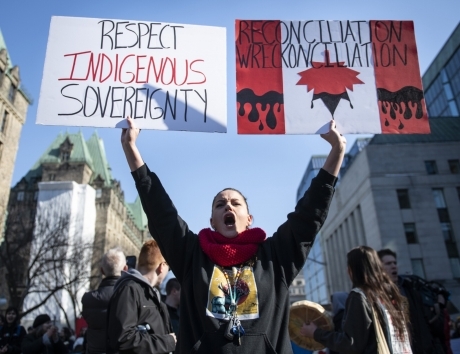
Resist the roll-back on Indigenous Rights
May 12, 2026
Justin Trudeau-era reconciliation was a cover for continuing “energy superpower” and extractive policies. Wet’suwet’en land defender and matriarch Freda Husan exposed this most clearly in 2020, declaring that “Reconciliation is Dead” after her arrest by invading RCMP officers on unceded Unist’ot’en territory. In response, the Indigenous-led Shut Down Canada movement exploded across so-called Canada creating a crisis for Trudeau that only abated with the onset of the Covid pandemic.
Under Carney reconciliation is stretched to the point of breaking.
This has not gone unnoticed globally. Amnesty International’s April 20th global human rights report noted that “several bills threatened Indigenous Peoples’ right to self-determination, including by expediting approvals for major infrastructure projects.” Ketty Nivyabandi, secretary general of the English Canadian arm said “Indigenous rights” were “rolling back.”
This roll back encompasses Indigenous sovereignty and inherent rights based on the land, which is being met by resistance.
RCMP raids on Mi’kmaq operated cannabis stores in Nova Scotia violate their treaty rights. Authorities are trying to divide the growing movement against the Tim Houston government cuts to social programs as the province gears up for more fracking, clearcutting and mining in the province.
BC NDP Premier Eby was forced to shelve his attempt to unilaterally amend the Declaration of the Rights of Indigenous Peoples Act (DRIPA) in the face of staunch resistance from First Nations across the province. But he hasn’t given up, and has proposed negotiating changes to the act with Indigenous leaders.
Proposed fast-tracking of energy corridors across Alberta, Saskatchewan, Manitoba and Ontario are ignoring the objections of Indigenous peoples. Opposition to Bill 5 and C-5 in Ontario led by Indigenous youth aims to protect the breathing lands, one of the largest stores of carbon on the planet, from “critical mineral” mining projects in the so-called “Ring of Fire.”
The roll back also includes attacks on basic human rights and dignity for Indigenous peoples across so-called Canada. This includes: the lack of clean water and healthcare provision on reserve; the targeting of Indigenous people by police forces and courts; the apartheid conditions faced by Indigenous people in employment, housing, life expectancy and health.
Government policies and anti-Indigenous racism on the far-right – including the denial that residential schools were part of a genocidal apparatus – is driving the roll back of Indigenous rights. These same forces are bludgeoning immigrant communities and the working class.
Fighting against injustice and racism in Indigenous and immigrant communities is not an optional add-on but is crucial to building the unity to win.
Indigenous leaders call out prison Injustice
The UN Permanent Forum on Indigenous Issues met in New York from April 20 to May 1. Governor General Mary Simon and Crown-Indigenous Relations Minister Rebecca Alty told the forum of “slow improvement” for Indigenous Peoples in Canada.
But other voices punctured this mood.
On April 21, Indigenous Peoples’ representatives and allies called for Canada to end the mass incarceration of Indigenous Peoples and shift $1 billion of the estimated $3 billion of federal prison funding to Indigenous governance.
Prince Albert Grand Council Grand Chief Brian Hardlotte said: “for decades, Canada has promised to reduce the overrepresentation of Indigenous Peoples in prison, yet today we make up just 5% of the population and one-third of those in federal custody, and half of incarcerated women.”
Assembly of First Nations National Chief Cindy Woodhouse-Nepinak connected this to the “massive apprehension of First Nations children under provincial and territorial child welfare laws” as “part of this systemic discrimination” that puts Indigenous “children into conflict with the law and often places their welfare at risk.”
Union of BC Indian Chiefs Women’s Representative Katisha Paul called for “real solutions [that] require the transfer of resources, jurisdiction, and authority to First Nations governments to lead restorative justice and healing in our territories.”
While the Canadian criminal justice system must ultimately be abolished for the rights of Indigenous peoples to be respected, it is important to support and amplify these calls for Indigenous led restorative justice and healing.
Indigenous Health versus Tar Sands Profits
The severe health impacts of tar sands tailings pond leaks for Indigenous peoples in northern Alberta has been known for decades. In the early 2000s, Dr John O’Connor noticed unusually high rates of rare cancers, autoimmune disorders and miscarriages amongst his patients in Fort Chipewyan – near to both the Athabaska Chipewyan First Nation (ACFN) and the Mikisew Cree First Nation (MCFN). Fort Chipewyan is on the shore of Lake Athabasca, downstream from Fort McMurray’s billions of litres of toxic sludge. When O’Connor raised these concerns in 2006 to the authorities, they investigated him for raising “undue alarm.”
In May 2022, the Imperial Oil Kearl facility tailings containment structures failed, leaking 5.3 million litres of toxic sludge. The company and the Alberta Energy Regulator (AER) not only did not attempt to repair the damage, but the public and nearby First Nations were not informed until February 2023!
ACFN Chief Allan Adam declared: “All trust with the Alberta government has been broken … they cannot be trusted to oversee this mess.” MCFN Chief Billie-Joe Tuccaro said “we fear that Kearl is just the tip of the iceberg. We are bracing for even more catastrophic events unless there are real reforms.”
But the reforms on offer from the Alberta government are to allow tar sands operators to “treat and release” billions of litres of tailings. Dr. Julia Sawatzky of the Canadian Association of Physicians for the Environment (CAPE) said this “risks irreversibly harming” the communities of more than 150,000 people “now and for generations to come.”
On April 13, Tuccaro announced the devastating findings of the MCFN health study, which they commissioned and funded themselves, unable to wait until 2034 for federal government action. It found that cancer rates in Fort Chipewyan are at least 25 percent higher than the rest of Alberta. Since 1993, there have been 149 documented cases in a community of 900 people – a “gross underestimate” since an additional 100 to 150 people have left the community and are no longer considered locals.
Tuccaro added that the full report will be released “once we get the Alberta Health Services (AHS) information, because without that, it’s incomplete.” The AHS has not provided data since 2022 which could corroborate a link between the Kearl tailings leak and spikes in cancer rates in the community.
Standing alongside ACFN Chief Allan Adam and Treaty 8 Grand Chief Trevor Mercredi, Tuccaro warned “we will stop the oil sands in the Wood Buffalo area until this is finalized.”
Proposed new tar sands crude pipelines to the BC coast would allow these operations to expand, when they should be shrinking to avoid global climate catastrophe. Building a livable future means supporting Alberta Indigenous peoples standing up for the health of their communities, their water and lands, and a livable future.
See more coverage by Brandi Morin on https://indigenousinsider.substack.com/
Cross Border Indigenous Solidarity
For Indigenous peoples on Turtle Island, the US-Canada border is an imaginary line that crosses the traditional territories of many Indigenous nations. In these times of surging Canadian nationalism against Trump’s threats, the Declaration of Kinship and Cooperation by First Nations leaders from Canada and the US at the UNPFII is an important example for working class communities. The declaration affirms a shared commitment “to advancing the rights, well-being, and self-determination of First Peoples across the Canada–United States border.”
Similarly, working class communities do not benefit by siding with their own bosses and rulers that are cutting social programs and jobs, driving down wages and oppressing migrants and Indigenous nations. True international working class solidarity allied with Indigenous nations fighting for self-determination can forge the path to liberation for all.
Section:


Featured Event

Events
-
October 18, 2026TkarantoOrganized by:International Socialists
-
October 18, 2026TorontoOrganized by:International Socialists
Recent Videos


Visit our YouTube Channel for more videos:

Visit our UStream Channel for live videos: