
|
Arts
You are here
Book tour revives the lost history of Jewish “partisans, revolutionaries, resistance fighters and firebrands ”
May 13, 2026
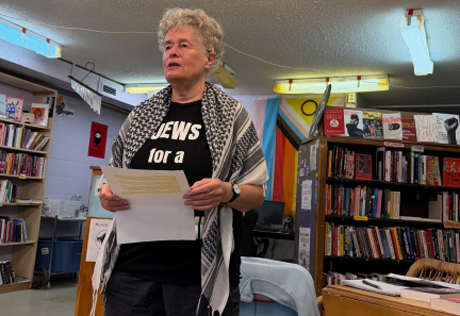
The cross country book tour for The Radical Jewish Tradition started with two events in Vancouver: May 2 at the Peretz Centre and on May 3 at Spartacus Books. Janey Stone, co-author with Donny Gluckstein spoke at both events.
Janey Stone’s mother came to Australia in 1938 to join part of her family. All the family members who remained in Poland died in the Holocaust. Janey is a life-long socialist, political activist and writer. She was a member of the International Socialists in Berkeley 1969-1971 and has remained a supporter of the concept of socialism from below ever since.
Janey was also involved in the Women’s Liberation Movement and the anti-Vietnam war movement, has been an active trade unionist and as an anti-Zionist Jew is a committed supporter of Palestine. Her book The Radical Jewish Tradition, co-written with Donny Gluckstein, is a contribution to this struggle.
Importance of history
At Spartacus Books, Janey explained to the crowd why the book is important for understanding Jewish history and workers' history, “Jewish history might seem a sort of niche history, interesting but not really very important to non-Jews. But there are two main reasons why this isn’t the case. Firstly there is the situation with Zionism and support for Israel being a crucial issue for us today.” She described the “Lachrymose conception of Jewish history,” which is the myth that Jews have always been victims without fighting back. “Jews fought back. The book is chock full of stories about Jews engaged in struggle against antisemitism and against their exploitation as workers. And they did this not as Zionists but as radicals and socialists of all kinds.”
She also disputed the claim that Zionists have historically represented the majority of Jews. Prior to 1948, Zionist organizations were always a small minority in Jewish communities. In the period of mass immigration from the antisemitism of the Russian Empire, Jews, “wanted overwhelmingly to go to US and secondarily places like UK, Argentina, Australia. Only 1 in 17 went to Palestine.”
She also discussed a few of the many examples in the book of how, “Jews have played a major role historically in many countries and circumstances.” One example is the Jewish Labour Bund in Lithuania, Poland and Russia which was the first workers party to organize in Tsarist Russia, and it remained the largest workers party until 1905. In 1903 at the second congress of the Russian Social Democratic Labour Party the Bund had “30,000 members compared to 8,400 of all the rest combined.”
Fighting antisemitism and capitalism
She explained why a group like the Bund that combined the fight against antisemitism with the fight against capitalism and the Tsar was so popular, “I think that at that period capitalism was still relatively raw and new and exploitation so open and brutal that linking oppression with exploitation didn’t present the relative difficulties it sometimes can today. At the turn of the century, with open pogroms happening and sponsored and promoted by government authorities, that anyone who called themselves a socialist would see how Jews were being scapegoated.
“I think this is clear in Lenin’s writing on the subject. There’s the famous quote: 'the Social Democratic leader’s ideal was to be 'the tribune of the people, who is able to react to every manifestation of tyranny and oppression, no matter where it appears, no matter what stratum or class of the people it affects.’
“This is a general statement but Lenin also said something that I think is very important: ‘Complete unity between the Jewish and non-Jewish proletariat is moreover especially necessary for a successful struggle against antisemitism, this despicable attempt of the government and the exploiting classes to exacerbate racial particularism and national enmity.’"
She also discussed the role of Jewish organizations fighting the Nazis across Europe. She talked about the “common myth that in the Holocaust, Jews went like lambs to the slaughter. Did you know that there were underground resistance movements in approximately 100 ghettos and armed uprisings in 50? There were also uprisings in 21 concentration camps and Jewish partisans in approximately 50 partisan groups. In addition about 10,000 people survived in family camps in the forest.”
The fight for a better world
She concluded with why this book should be read by everyone fighting for a better world, “the most important conclusion from this history isn’t specific to Jews at all. It’s the fact that this history shows the possibility of solidarity, and of uniting the fight against exploitation with the fight against oppression – the struggle against all forms of racism as well as other forms of oppression that are so central and visible in the world today – from women through to sexual identity to disability. Lenin’s tribune of the people represents the only way that all the oppressed will be able to find liberation. The current vogue of identity politics points in the direction of separation of struggles. We as socialists point in the direction of a combined struggle, based on mutual interests, with the possibility of defeating the capitalist and imperialist system that generates both exploitation and oppression.”
The book tour continues in Toronto on Sunday May 17 at 2PM in person and online, click here for details and in Winnipeg on Satrurday May 23 at 7PM in person and online, click here for details. The complete cross country schedule is here.
Section:


Featured Event

Events
-
October 18, 2026TkarantoOrganized by:International Socialists
-
October 18, 2026TorontoOrganized by:International Socialists
Recent Videos


Visit our YouTube Channel for more videos:

Visit our UStream Channel for live videos: