|
Reports
You are here
Frack Off Tim Houston: resist new Nova Scotia onshore gas
June 5, 2026
The Tim Houston government passed legislation last March to lift the moratorium on fracking that had been in place since 2014, and in December they allocated $30 million for exploring new “onshore gas” developments in Nova Scotia. This January they signed an agreement with Dalhousie University to administer the Subsurface Energy R&D Investment Program (SERDIP), despite growing scientific evidence of the dangers of fracking.
This method of extracting fossil gas – mainly methane – involves injecting a pressurized liquid into rock formations to crack them, allowing the gas to be captured. Methane, a much more potent greenhouse gas than carbon dioxide, inevitably escapes. The cracks also allow fresh groundwater to be contaminated with toxins, including radioactive elements, and the fractured rock is prone to earthquakes.
Add to this the urgent need to stop burning fossil fuels if we hope to have a livable future.
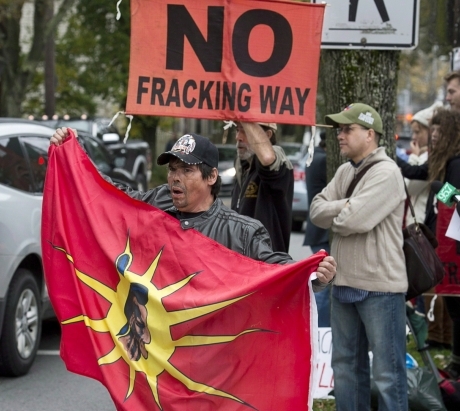
A mass movement erupted over a decade ago against fracking developments by Alton Gas. At the centre of this resistance were the Mi’kmaq communities and their Chiefs who refused to give their consent. Mi’kmaq activists built traditional “truckhouses” on site, physically blocking the development. The Nova Scotia Fracking Resource and Action Coalition (NOFRAC) was instrumental in building the campaign against fracking. The Dean of Management at Dalhousie University, David Wheeler, chaired the Nova Scotia Independent Review Panel on Hydraulic Fracturing (2013-2014) that recommended that fracking was stopped. The combined pressure from the movement and this expert panel ultimately led to then Premier Stephen McNeil imposing the fracking moratorium.
The reversal of this decision by the current government is part of sweeping changes that side with extractive industries to the detriment of the people of the province, and especially Mi’kmaq communities: a moratorium on uranium mining in place since 2009 has also been lifted; massive cuts to arts, social programs and education; stranding striking CUPE long-term care workers on the picket line for six weeks as they fight for a living wage; fast-tracking fossil fuel electricity plants in Salt Springs and Marshdale without Mi’kmaq consent; ramped up RCMP attacks on Mi’kmaq run cannabis stores that are really attacks on treaty rights.
This follows other attacks. Last September, the government introduced legislation imposing $50,000 fines and/or six month sentences for “impeding access to” forest access roads on Crown lands, after Mi’kmaq people camped at Hunter’s Mountain to prevent clear cut logging on their traditional hunting territory.
SERDIP has other problems that have been raised by NOFRAC in a report released in April. The Province is in control of the program, and Dalhousie University must vet any public communications with the Province which owns and controls all information including data, working papers, evaluation and research. This undermines the credibility of Dalhousie University and means that public access to information regarding fracking development will be limited.
The program plan is to award exploration agreements to “successful proponents” by May and conduct exploratory drilling by July through October. Although the government claims to be consulting with Mi’kmaq communities, there is no way proper consultations could happen on this timeline, not to mention “free, prior and informed consent.”
In truth, the Mi’kmaq made their position clear last year when the moratorium was lifted: “The Mi’kmaq of Nova Scotia and the Assembly of Nova Scotia Mi’kmaw Chiefs continue to remain opposed to hydraulic fracturing and will not see it happen in our unceded and traditional territory.”
Sipekne’katik First Nation Chief Michelle Glasgow added: “Environmental racism is a real thing. The Province of Nova Scotia and Premier Houston are making decisions and moving at a speed that appears rooted in racist and colonial practices. They continue to marginalize the voices, position and concerns of the Mi’kmaq.”
The government, fracking companies and Dalhousie University are pushing a destructive, anti-Indigenous agenda. Premier Tim Houston said in late May that there has been interest in participating in SERDIP by seven companies and they have begun talking with one of them.
But the resistance is growing and is sure to explode on the streets and at the sites of exploratory drilling as they develop, building on the success of the Shoulder to Shoulder campaign that pushed back against the mean-spirited budget earlier this year. Building the links between militant workers - such as long-term care workers on strike against the Province - with the Mi’kmaq led movement fighting to stop fracking is crucial.
Fracking was stopped before and it can be stopped again through mass mobilizations from below.
Section:


Featured Event

Events
-
October 18, 2026TkarantoOrganized by:International Socialists
-
October 18, 2026TorontoOrganized by:International Socialists
Recent Videos


Visit our YouTube Channel for more videos:

Visit our UStream Channel for live videos: