|
News
You are here
World Cup: Corporate greed games
June 12, 2026
The parliamentary budget office says the world cup will cost us more than $1 billion in public funds. This money is allocated for infrastructure, security and promotion for the games. Toronto is paying $380 million and Vancouver as much as $624 million to host events. The price will be paid by both municipal governments and from the federal government.
At a time when people are being squeezed by a cost of living crisis, this is a ridiculous priority for government spending. While there will be an influx of cash as a result of the games, history has taught us that this will go to a small number of people. The hotel magnates, airlines and bar owners will be flush with cash as the workers struggle to keep up with the rise in workloads.
Michelle Travis, a spokesperson for Unite Here Local 40, which represents hotel workers in Vancouver said workers are expecting to see workloads increase but pay will stay the same. They are planning to protest during the world cup. “The [workers] want to make sure that they are valued for the work that they provide, and they want to make sure that it’s not just the hotel owners and FIFA that are going to do well from this,” Travis told Global News.
There is always money available for billionaire sporting events but once again the working people — who will have little access to the actual events — will pay.
In Mexico, striking teachers have made the connection. While President Claudia Sheinbaum has said there is no more money for education workers they are forking out millions for the games. Teachers have vowed to shut down events if their demands for pay raises are ignored.
Teachers were brutally attacked by police at a march to the FIFA “Fan zone” in Mexico City this week. CNTE union general secretary, Pedro Hernandez Morales spoke at the rally and said that “the ball will not roll” if their demands are not met.
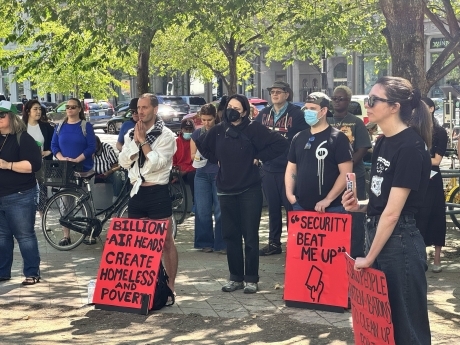
In both Toronto and Vancouver, concerns have been raised about how police are pushing homeless people out of the downtown areas near the world cup venues.
The Toronto Underhoused and Homeless Union (TUHU) held a rally downtown to denounce violence against the poor and homeless. Rev. Angie Hocking, a member of the TUHU, said the violence is “out of control”. “This city’s push to clean up the streets has meant more policing, more displacement and more violence towards unhoused people” she said.
The TUHU released a report titled, Safety for Whom? documenting the abuses by Toronto police and private security which has grown significantly as FIFA related tourism has increased.
Sport vs corporate control
Sports are a welcome distraction for billions of people worldwide. There is a thrill from the spectacle and a camaraderie with fellow team supporters that helps beat back the isolation and boredom of an otherwise drab life. It is one of the few entertainment mediums that isn’t immediately predictable and doesn’t insult your intelligence.
But as is the case with every endeavour that operates under the profit motive there is a dirty underbelly of exploitation, corruption and violence.
Billionaire team owners are frequently given huge amounts of public money to attract teams to certain cities and or for venue construction. FIFA itself has been involved in dozens of corruption scandals. In 2015 FIFA officials were charged by the FBI for corruption and money laundering to the tune of $150 million.
Dave Zirin in his book Bad Sports: How owners are ruining the games we love, outlines how the sports-industrial complex has become a showcase for the politics of the right-wing owners who prioritize profit above all else and has reshaped the politics of urban centres.
“The owners seem to be saying that it’s their world and we just live in it even if our taxes pay for their stadiums with every unfilled pothole and under-funded library. It’s time to upset the setup.”
He argues that the billionaire owners have to be stripped of their power and teams should be handed over to communities to make the games accessible to working people and end the corruption.
Protest and world spectacle
There is a long tradition of global sporting events becoming a site of protest from the classic raised fist black-power salute by Tommie Smith and John Carlos at the 1968 Mexico City Olympics to the poignant protest at the Paris Olympics where Algerian athletes threw red roses into the Seine river to commemorate the 120 Algerians killed by police during protests against French colonial rule in 1961.
This world cup comes at a time of heightened political polarization and protests are inevitable. In the US, there are already planned protests against ICE agents who will be present at most venues using new facial recognition tech to identify and round up suspected “illegal immigrants”.
Trump has also banned members from the Iranian team from being housed in the US forcing them to travel to hotels in Mexico after each game.
And the Israeli genocide in Gaza is already part of this backdrop as zionists are attempting to ban Lamine Yamal from entering the US after he hoisted a Palestinian flag during his club teams victory in the Spanish league.
As with everything under capitalism, the conflict between billionaire owners and the working people who actually pay the bill will continue to erupt. We need to end the corporate greed that dominates these games and return sports to the people.
Section:
Topics:


Featured Event
Events
-
October 28, 2026VancouverOrganized by:snəw̓eyəɬ leləm̓ Langara International Socialists
Recent Videos


Visit our YouTube Channel for more videos:

Visit our UStream Channel for live videos: