
|
Arts
You are here
Winnipeg Nakba exhibit uplifts Palestinian voices
June 29, 2026
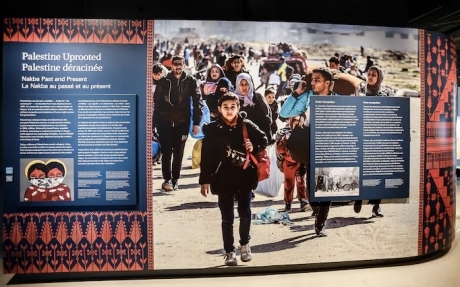
Palestine Uprooted: Nakba Past and Present opened at the Canadian Museum for Human Rights (CMHR) in Winnipeg on Friday June 26th, and in French on Saturday June 27th.
The purpose of what became known colloquially as “the Nakba exhibition” was to use a national institution for historical education for Palestinian Canadians to relate their own and their families’ experiences of the Nakba. The Nakba, Arabic for “calamity,” took place when the Israeli state was establishedthrough forcible and violent displacement of Palestinian inhabitants of the land in May 1948. Palestinian Canadians in Winnipeg have been requesting such an exhibit since the CMHR opened in 2014, so they could have a voice among the stories of other groups who have suffered human rights violations, discrimination, oppression, apartheid, and genocide.
The advisory network involved with research for the exhibition included several Palestinian academics and one Jewish academic from various parts of the country, as well as two local Palestinian community leaders from Winnipeg. Head curator of the exhibition, Isabelle Masson, estimated that there were 50 or more people involved in the various aspects of the development and construction of the exhibition from start to finish.
The exhibition instigated a great deal of fear among people invested in the zionist myth of how the Israeli state was established. Groups such as the Centre for Israel and Jewish Affairs (CIJA) and the Jewish Federation of Winnipeg fought the exhibition's development in one or another way since it started.
In the days leading up to the opening on Friday the 26th, outlets like the National Post and the Globe and Mail repeatedly published the arguments of the groups that took issue with the exhibition. While they sometimes made space for counterarguments that supported the exhibition, any such counterarguments were immediately followed by the publication of more objections. Capitalist media gave an outsized voice to the zionists, which is consistent with their coverage of the genocide in Gaza and Palestinian struggle in general.
By contrast, some in-depth coverage should be emerging from The Breach in the coming week, as well as ongoing coverage from Samira Mohyeddin, the Toronto-based journalist and owner of On the Line Media, who left the CBC to become independent.
A statementwas released by Independent Jewish Voices, the Jewish Faculty Network, and the United Jewish People’s Order the day before the opening to counter the objections. It was used in some of the recent press coverage of the opening, but its use was limited because it supports the exhibition, whereas mainstream media outlets tend to seek out controversy. Moreover, these are the voices who want to challenge the status quo, which is not in the interests of these outlets. The zionist organizations, whose interests intersect with those of the State (and therefore with policing as well), repeat the statistic that 94% of Jews in Canada “support the existence of a Jewish state in Israel.” This statistic is highly suspect, given the political perspectiveof its author. In addition, what the original claim actually saiddoes not always square with how it is weaponized against Jews with the "wrong" opinions.
Regardless, the exhibition opening encountered no direct disruptions or anything that prevented the event from being relished by the 750 people present. On the third floor of the museum, Palestinian women led tatreez (traditional Palestinian embroidery) workshops, accompanied by a live oud performer. On the fifth floor, people were permitted a walkthrough of the exhibition itself. Visitors were greeted to a reception on the ground floor, where the evening ended with speeches by the CEO of the CMHR, Isha Khan, and a slideshow presentation by curator Isabelle Masson, who also provided a verbal guide through the exhibition. Khan stated that she stood by the decision to persist with the exhibition despite the intense pressures on her from several directions. Palestinian Canadian youth recited poems selected by the museum, such as Revenge by Taha Muhammed Ali.
Zionist protesters showed up in larger numbers than they normally would in Winnipeg, with estimates at around 200. Present among them was Gail Asper, a trustee of the Asper Foundation and daughter of Israel (Izzy) Asper, the philanthropist responsible for initiating the proposal for the museum that became the CMHR. She had been raising concerns with the so-called one-sidedness of the exhibition. Protesters were a long way from the museum entrance, so had no impact on the event inside.
The exhibition is very small. Members of the United Jewish People's Order and the Jewish Faculty Network took a humorous but pointed photo of themselves using a tape measure on the space, to compare its dimensions with the space taken up by other exhibitions. When coming face-to-face with these humble proportions, many attendees of the opening commented on how the reactions against the exhibition appeared to be out of proportion. Yet the amount of physical space taken up by Palestine Uprooted is not what is at issue for the people who object to it, who fear the very idea of the exhibition. It is threatening to the zionist account of history that visitors to the museum may learn a different version of that history than the one used to rationalize the ethnic cleansing and forced displacement of 750,000 Palestinians from over 500 villages in 1948. Zionists do not want people to be exposed to different conclusions than those of the Canadian state, which reinforces ideological and material support for the Israeli state’s genocide in Gaza.
At the same time, the broad polls in most English-speaking western countries whose governments still support the Israeli state would suggest that the cat is out of the bag: most people recognize the oppression of Palestinians through the violence of Israel, and most people do not support it continuing.
As a federally funded institution with philanthropic contributors, there are limits to what this exhibition means for anyone suffering inside Palestine today. Socialists know that any institution such as a national museum is beholden to interests much larger than a principled CEO with a human rights law background, and that such institutions do not serve the goal of smashing the capitalist state or the struggles against oppression brought about by capitalist imperialism and settler-colonialism. But symbolic or reformist victories can still be real victories. Museums are a bridge, in that they can communicate with a wider, less radicalized general population, and therefore play an important role in the public education of such human rights issues as anti-colonial struggles. It is therefore significant what kinds of stories they do and don't include.
Section:


Featured Event

Events
-
October 18, 2026TkarantoOrganized by:International Socialists
-
October 18, 2026TorontoOrganized by:International Socialists
Recent Videos


Visit our YouTube Channel for more videos:

Visit our UStream Channel for live videos: