|
Features
You are here
The Canadian state, Alberta referendum and Indigenous Land rights
August 19, 2026
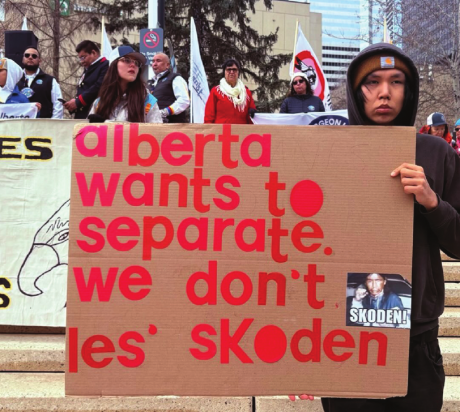
Premier Smith’s separation referendum in Alberta gives two bad choices to Albertans and violates the treaty rights of Indigenous nations within the borders of the province.
Her referendum question asks, “Should Alberta remain a province of Canada or should the Government of Alberta commence the legal process required under the Canadian Constitution to hold a binding provincial referendum on whether or not Alberta should separate from Canada?”
Canada is a settler-colonial nation based on ethnic cleansing and genocide. All the gains that workers have wrested from our ruling class such as universal healthcare, education, human rights and environmental protections are currently under attack to increase the profits of the 1%. There is nothing to be gained from allegiance to Canada. However, this referendum isn’t about looking after people in Alberta, it’s about increasing the power of oil and gas companies in Alberta and furthering the Smith government’s agenda of healthcare privatization and other attacks on workers.
This new referendum question replaces questions directly on separation that were submitted to Elections Alberta twice. And twice were ruled against by the courts. The latest version of the question asked, “Do you agree that the Province of Alberta should cease to be part of Canada to become an independent state?”
Smith's attack on treaty rights
This is an attack on Indigenous treaty rights and self-determination. This was pointed out to Premier Smith weeks before the Court of King’s Bench of Alberta ruled that Elections Alberta should have rejected the separation petition and that the signatures can not be counted and verified. On May 1, Athabasca Chipewyan First Nation (ACFN) de- livered a nearly 593 page submission to Smith’s cabinet explaining their Nation’s opposition to a separation referendum and the basis in both co- lonial and Dené law that would forbid it. Cabinet never responded.
The ACFN submission to both the cabinet and the courts point out that Alberta did not exist when their Treaty 8 was signed. At that time, Alberta was only a district of the Northwest Territories, and modern Alberta includes that district and the district of Athabasca. Unlike some other provinces Alberta didn’t join confederation, it was created by Canada. In their submission ACFN Chief Allan Adam writes, “it was First Nations’ consent to non-Indigenous settlement through the Treaties that led to the creation of Alberta. It is our ongoing commitment to honour the Numbered Treaties that legitimize Alberta today. First Nations are founding partners in the creation of Alberta. We cannot simply be ignored or bypassed by a majority vote among newcomers in favour of secession” He concludes from this that, “Alberta should not be permitted to leave with the lands and resources that the Treaty brought into Confederation – lands that Indigenous people have taken care of for millennia. I have said this before – anyone who wishes to leave these lands is free to leave with all the lands they brought with them – that is to say, with nothing.”
Alberta is not an oppressed nation
The Dené nation has exercised its right to self-determination for thousands of years before the colonial state was created and they have continued to do so since then. The submission explains this: “Peoples capable of asserting a right of self-determination have distinct and separate rights of self-determination from those held in common with all the citizens that live within the nation state. The Dené, as a distinct and proud people, have this right of self-determination.” From this Chief Adam concludes, “To call Albertans an oppressed people and to assert that Albertans share the struggles of colonized people is as offensive as it is absurd.”
The ACFN submissions to the provincial cabinet and to the court explain how their traditional lands extend into Saskatchewan and the Northwest Territories. Their “hunters routinely cross provincial and territorial borders in canoes, quads, snowmobiles or pickup trucks with their rifles, shotguns and ammuni- tion. Those provincial and territorial borders do not dictate how our mem- bers exercise their Treaty rights.” Requiring their members to travel across an international border at the nearest road would turn a 100 km journey into a 700 km journey.
The treaties between the ACFN and other nations are not with the province of Alberta and the province can not unilaterally change or amend these treaties. This is the reason for the court decision that even the petition to hold a referendum on separation and the referendum itself can not proceed without consultation by the Crown. Chief Adam tried to explain this to the Premier and her cabinet: “Our law and protocol demand that if you are considering changes like this, that you come to our leadership first, before opening the question to the public . . . changes to the Treaty relationship without solemn dialogue in the spirit of reconciliation would be a profound breach of Dené law.”
Referendum = racism
The ACFN submissions to cabinet and the courts also contain many examples of the anti-Indigenous racism that has escalated in recent years. Social media defending Alberta separatism goes from rehashing old slurs against Indigenous people and their leaders to threats of violence. As this process proceeds the racism and violence will intensify.
Despite all this the Premier is going ahead with a referendum that will fuel anti-Indigenous racism and regardless of the outcome do nothing to help the people within the borders of Alberta.
After the Premier’s announcement of the new question the ACFN responded with a media release. Chief Adam referred to the earlier court decision, “Once again, the court has recognized the constitutional duty to consult, but this is not just a victory for Indigenous people. When the court upholds the constitution, it affirms everyone’s rights. This is a victory for all patriotic Canadians.”
While we believe that the Canadian state is a prison house of nations that deserves to be dismantled, in this case we fully support the right of Indigenous Nations to chart their own course of action in nation-to-nation treaty rights negotiations.
Describing the new referendum question, Chief Adam stated: “This entire mess has been a cynical political exercise by the Premier. It serves no one in Alberta. A referendum on whether to hold a referendum is not a clear question. This whole thing is a waste of time and money.” The ACFN has asked Prime Minister Mark Carney to put the new referendum question before parliament as required by the Clarity Act and they expect Parliament to use their power under the act to prevent the referendum.
The Alberta government has previously scheduled referendum questions for October 19. The new separation question will join five questions on taking away rights from migrant workers in the province and four questions related to giving the Alberta government more power to degrade public services, override federal laws, select judges and abolish the senate. Tellingly, there are no referendum questions that would require Alberta to spend more on healthcare or education, to raise wages, or to protect human rights.
No good choice
There is no good choice in this referendum. It ignores Indigenous rights, it is designed to pit workers against each other and to fuel anti-Indigenous racism and grow the far-right. Workers in Alberta and elsewhere in so-called Canada need higher wages, an emergency response to the climate crisis, an end to militarism, and more to deal with the overlapping crises of a system in decline. Calls to support settler colonialism in its Canadian or its Albertan form will set back all progressive movements. The Alberta Federation of Labour has issued a call for support for Indigenous resistance . Inside and outside of Alberta we should call for solidarity with Indigenous Nations, and take on Smith and Carney in the fight for a better world.
Section:


Featured Event

Events
-
October 18, 2026TkarantoOrganized by:International Socialists
-
October 18, 2026TorontoOrganized by:International Socialists
Recent Videos


Visit our YouTube Channel for more videos:

Visit our UStream Channel for live videos: