|
News
You are here
Reject Maple Leaf Militarism
July 9, 2026
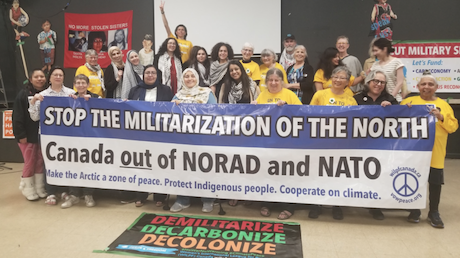
Mark Carney said in Davos that the post WWII world order is breaking. Not because of the continuing genocidal occupation of Gaza, the ongoing war in Ukraine, or the US and Israeli war on Iran, but because Trump’s threats against Canada and Greenland have intensified North Atlantic and Arctic inter-state tensions.
The US already has military bases in Greenland, a colony of Denmark called Nunarput by the Inuit. Trump’s threats to take over challenge another colonial power with no regard for Inuit sovereignty. Similarly, Canada’s Arctic security partnership with Scandinavian powers disregards Inuit sovereignty. Carney also devalues Venezuelan, Cuban, Palestinian, and Iranian sovereignty, and stands ready to commit Canada to “a military role” against Iran.
Canada increasingly seeks to participate more aggressively within the imperialist order. Canada’s militarization is, above all, a class project of rearmament, extraction, heightened border security, and austerity.
No innocent Canadian nationalism
There is no innocent Canadian nationalism. In periods of sharpening global imperialist rivalry, nationalism presents the interests of the ruling class as the common interest of the nation. Militarization serves those interests with budgets, weapons, logistics, police powers, and a sense of urgency. Carney’s government uses the language of resilience and sovereignty to secure working-class consent, boasting of their increasing military spending, now reaching $63 billion and climbing.
Carney’s Defence Industrial Strategy promises to “rebuild, rearm, and reinvest,” create 125,000 jobs, significantly increase military exports, rapidly increase Canadian sourcing of defence contracts, and align critical-minerals projects with national defence priorities. For Carney, “The work of defending Canada is the work of building Canada.” Defense is now infused into industrial policy, regional development policy and labour-market policy. Canadian capitalism is being refocused around armed capital accumulation. The state- owned Business Development Bank of Canada has already allocated $5 billion for defence, funding companies developing technologies for military and civilian use. Benjamin Bergen of the Canadian Venture Capital and Private Equity Association called this a “seismic shift,” as financial institutions begin removing previous defence investment restrictions.
This fusion is most concrete in the Arctic, where so-called Canadian sovereignty meets its arch-enemy: Indigenous nations and their land. Roads, ports, hydro expansion, radar systems, military readiness, and critical-mineral corridors are being bundled strategically. The Grays Bay Road and Port Project, the Mackenzie Valley Highway, and the Taltson Hydro Expansion are all framed as infrastructure to protect sovereignty and drive northern prosperity: materially, they serve to unlock and move critical minerals and other strategic resources. For Canada, this is security. For capitalists, opportunity. This militarized extraction rests on intensified subordination of Indigenous nations and lands to Canadian capitalist interests.
Bill C-5: facilitating militarization
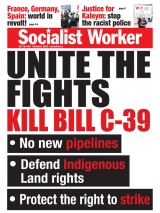
Federally, Bill C-5, the One Canadian Economy Act, created a fast-track framework for projects deemed in the “national interest,” compressing review timelines and concentrating power in cabinet. This undermines Indigenous rights, as does Bill 5 in Ontario, that allows the cabinet to accelerate mining and resource projects in the name of economic urgency. Both laws facilitate militarization. Rearmament requires logistics, energy, minerals, corridors, and executive power. Threatened sovereignty justifies fast-tracking extraction and containing Indigenous resistance.
The same pattern exists at the border. Bill C-12 tightens access to asylum, expands executive power over migrants and enables mass deportation while closing borders. Meanwhile, Ottawa is preparing broad program cuts across federal departments while shielding National Defence, the CBSA, and the RCMP. This expands the domestic architec- ture of militarization with a stronger coercive apparatus, a harsher border regime, and weaker social provision. Rearmament will be funded not by capital, but by workers, migrants, students, Indigenous communities, and those relying on public services.
None of this is new. The Canadian state has always used the language of emergency, security, and national unity to suppress resistance. Long before WWI, Indigenous resistance had already been criminalized as treason and sedition. After the defeat of the North-West Rebellion of Métis and Plains Cree peoples in 1885, Louis Riel and eight Plains Cree leaders were tried and executed by the Canadian state. During WWI, enemy-alien registration, internment, censorship, disenfranchisement, anti-strike measures, and wartime coercion expanded dramatically. The 1918 conscription riots in Quebec were crushed, killing five protestors. The Red Scare after the Winnipeg General Strike in 1919 strengthened centralized anti-radical mechanisms. These historical truths contradict the myth of Canada as a modest and peaceable nation. Canadian nationalism has always been coercive, especially when the stakes for capital are high.
The main enemy is at home
That is why we have to remember the history of the Second International. Before 1914, International congresses denounced war and pledged international working-class resistance. But when WWI came, most social democratic parties collapsed into patriotic support for their own states. German Social Democracy voted for war credits, declaring that the triumph of “Russian despotism… would put much if not everything in question for our nation and its future freedom. It is necessary to fend off this danger and to secure the culture and independence of our own country. … We will not forsake our fatherland in its hour of need.” French and Belgian worker leaders also invoked national defence, while the British Labour leadership justified war in the name of democracy. Karl Liebknecht countered this patriotic frenzy by declaring: “The main enemy of the German people is in Germany itself: German imperialism, the German war party, and German secret diplomacy. The German people should combat this enemy, located in their own country. This is a political struggle to be waged in collaboration with the proletariat in other countries, who are battling their own native imperialism.”
The same political trap is being laid again. The working class and Indigenous nations across Canada and the US have interests separate from both the colonialist-capitalist class in Canada and the fascistic oligarchs in the US. Carney’s liberal nationalism rallies workers behind rearmament to resist Trump. This does not resist imperialism, but strengthens one of its nodes, Canadian imperialism, while fuelling anti-immigrant racism, austerity and justifying settler-colonial domination. Canada claims to be reducing dependence on the US, but is doing so within NATO, with integrated defence-industrial planning, and increased inter-state competition over the Arctic, minerals, supply chains, and strategic geography.
Resistance from below
So where does hope lie? On March 28, eight million people joined the No Kings protests across the United States against Trump, ICE repression and war, including major demonstrations in Minnesota, New York, and Chicago. In Britain, over half a million people marched in London against the rise of Reform UK and the far right. In Ontario and Nova Scotia, students and grassroots movements are mobilizing against government austerity attacks on education, healthcare and housing. Indigenous land defenders and water protectors from coast to coast to coast are standing up to the fast-track agenda.
These struggles point away from nationalist alignment with “our” rulers and toward mass resistance from below, crucially involving workers. The task is to build solidarity internationally, linking the fight against fascism, war, austerity, racism, deportation, privatization, and colonial dispossession into a common struggle against imperialism, that is, capitalism itself. As Rosa Luxemburg wrote in 1911: “Militarism in both its forms, as war and as armed peace, is a legitimate child and a logical result of capitalism, and can only be overcome with its destruction. Hence whoever honestly desires world peace and liberation from the tremendous burden of armaments must also desire socialism.”
Section:


Featured Event
Events
-
October 18, 2026TkarantoOrganized by:International Socialists
-
October 18, 2026TorontoOrganized by:International Socialists
Recent Videos


Visit our YouTube Channel for more videos:

Visit our UStream Channel for live videos: