
|
Reports
You are here
Support TS2023 work permit extensions - Blame billionaires not immigrants
July 10, 2026
In February 2023, two earthquakes shattered Turkey and Syria – magnitude 7.8 and 7.7 – killing almost 60,000 people and injuring over 120,000 more. More than 25 million people were affected by the twin quakes that destroyed almost a million homes, severed road and communications infrastructure and undermined agriculture in the region.
People and nations around the world donated money, supplies and personnel to support search and rescue efforts, humanitarian aid and rebuilding efforts.
Immigration, Refugees and Citizenship Canada (IRCC) also created a special humanitarian program for Turkish and Syrian people affected by the disaster – known as TS2023 – to stay for 3 years in Canada under open work permits, and extend the status of those who were already here. IRCC granted similar provisions to Ukrainians who fled after the Russian invasion.
Approximately 20,000 people came to Canada as a result, residing in cities and towns across Canada. Like the vast majority of immigrants, they contributed to Canada in a myriad number of ways. They brought money that has contributed to the Canadian economy. Those who could find it, worked in jobs such as delivery drivers, food service workers, construction workers, teachers and engineering consultants.
Whole families came and became part of communities across Canada in school, at work and at play. Children have been born here. While the majority of those who came under TS2023 have left Canada, at least 3,000 people are still here. After their homes and communities were destroyed back home, they rebuilt their lives here, though it has not been easy. Rebuilding has been slow in the earthquake affected regions, and their main hope is that their children can grow up here.
Unlike the Ukrainian humanitarian program, TS2023 did not last long: in January 2024, IRCC stopped accepting applications, which are now expiring. Now this community is in crisis, facing an uncertain future in the face of increased border controls and shrinking pathways to permanent residency and citizenship.
They argue they’ve obeyed all the rules, have worked hard to rebuild their lives after the devastation in Turkey and Syria, and are not a burden on Canada. Liberal MP Sima Acan sponsored petition e-7288 calling for a minimum 2-year extension of TS2023 work permits, Labour Market Impact Assessment (LMIA) exemption and a new pathway towards permanent residency.
The Minister of Immigration, Refugees and Citizenship, Peter Fragiskatos, rejected the petition in early June arguing that the “measures were intended to be temporary in nature.”
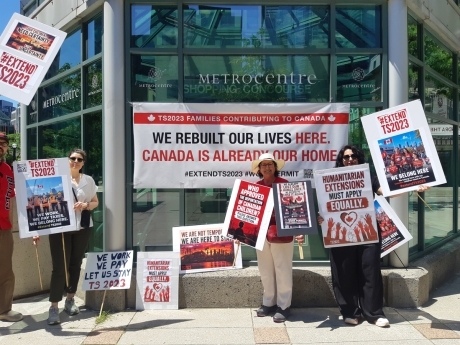
Undeterred by this rejection, TS2023 work permit holders are taking to the streets to raise the visibility of their struggle. Rallies and marches were held on the weekend of June 27 & 28 and raised their demands in Halifax, Montreal, Ottawa, Toronto, Calgary, Edmonton and Vancouver.
And the organizers vow to continue mobilizing, including a walk from Toronto to Ottawa this summer.
They must be allowed to stay. Their struggle is one of many by migrant workers, temporary foreign workers, immigrants and post graduate work permit holders against increasingly restrictive and racist border controls. Canadian bosses and political leaders scapegoat all these workers whose legal rights are curtailed, while profiting enormously from their labour and the money they bring to the country. Working class power is weakened when the rights of some workers are restricted. Only bosses benefit through the super-exploitation of racialized migrant labour. That is why socialists must argue for the abolishment of border controls on people and for the full and equal rights of all who arrive on these shores from elsewhere.
Most of the people of Canada are immigrants, whether they came here hundreds of years ago or arrived last week. It is only Indigenous peoples that are not immigrants. In southern Ontario, the Dish With One Spoon Wampum Belt Covenant – a treaty between the Anishinaabe, the Mississaugas of the Credit and the Haudenosaunee that predates Canada – invites all newcomers to share the land and its resources in order to sustain it for future generations. Indigenous understandings of treaties across so-called Canada similarly call on settlers to be “treaty people” and honour their commitments to stewarding the land for future generations. It is the capitalist ruling class of Canada, that has consciously pursued genocidal settler colonial policies to claim the land and resources, that has not honoured these treaties. Workers have no objective interest in supporting these policies and can be won to support a radically different future.
While we support the TS2023 campaign, there is some problematic language in some of the slogans put forward that emphasize the “legal” nature of their community. This is an understandable defense mechanism because the attacks on immigrants are fierce. But slogans such as “Are we being punished for not being a burden to Canada” that was seen on a social media post implies that other groups seeking status in Canada are a burden and thus not worthy of staying. This cedes ground to the far right, who scapegoats immigrants for the impacts of government policies on housing, healthcare, jobs and social provision. There must be a way for TS2023 campaigners to make their demands while building bridges to other immigrant, migrant and temporary foreign worker communities – and those seeking refugee status – who face similar (and worse) conditions under Canada’s racist immigration policies.
Building the links between these immigrant communities under attack, and with workers organized in unions can build a powerful movement to challenge these attacks.
Blame billionaires not immigrants.
Section:
Topics:


Featured Event

Events
-
October 28, 2026VancouverOrganized by:snəw̓eyəɬ leləm̓ Langara International Socialists
Recent Videos


Visit our YouTube Channel for more videos:

Visit our UStream Channel for live videos: