|
News
You are here
Climate justice now
July 13, 2026
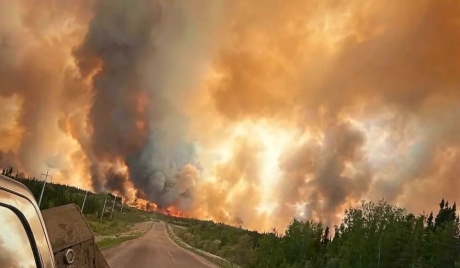
Picture from a resident of the O-Pipon-Na-Piwin Cree Nation - forced to evacuate to escape wildfires
This summer the mercury has reached skyrocketing levels around the globe. Across Europe, North America, and India, extreme heat has led to a large number of deaths by devastating heat waves. The cause of these deadly temperatures is known: fossil fuel emissions filling the atmosphere with carbon and slowly boiling the planet.
In May, a heat wave spreading across India was exacerbated by local water shortages, leading to an estimated 3,400 excess deaths per day. In late June, Europe saw its most extreme temperatures since the historic heat wave of 1976. It smashed records in nearly every country and caused more than 3,700 excess deaths in France, Belgium, and the Netherlands alone—a number likely to rise to tens of thousands in the coming weeks. A rising El Niño has begun super-charging summer heat and storms in North America, bringing deadly temperatures and flooding to parts of Canada and the US.
And yet, the governments of the global north turn their backs on known solutions and pour investment into the fossil fuel industry amidst increasing global political and economic instability.
Even before they can be announced, the consequences of these short-sighted policies are coming home to roost.
Pipe-ing Hot
In Canada in recent weeks, wildfires have forced evacuations in Labrador, in West Kelowna and Fraser Canyon BC and in two First Nations in Northwest Territories. Several western Manitoba communities have experienced severe flooding, and the Sioux Valley Dakota Nation declared a state of emergency and prepared for evacuation. The heat wave in southern Ontario fueled a series of severe storms, forcing Carney to cancel his flight to a planned Canada Day event in Edmonton.
Regardless, the Carney government is doubling down on fossil fuels, recently abandoning their 2030/2035 emissions targets. In April, it approved a $4 billion expansion to the Enbridge Sunrise pipeline in BC, which currently carries 3.6 billion cubic ft/day of fracked gas to the US border. In May, the Major Projects Office approved the Ksi Lisims LNG port facility in Nisga’a First Nation in northern BC, as Germany agreed to a multi-decade, million ton LNG purchase. The LNG Canada terminal at Kitimat is expanding to double capacity. And in recent days the governments of Alberta and Ontario announced the Northern Shield pipeline, to funnel 500,000 to 800,000 barrels of oil, gas, and other products for export to Europe.
The largest of these plans is a massive new trans-mountain tar sands crude oil pipeline, running from central Alberta to BC. The state-owned Trans Mountain Corporation would pay over 90% of the costs—tens of billions of dollars that would take decades to recover. Yet Carney praised the plan as “another very profitable pipeline”.
Extracting wealth, exporting disaster
In 2022, climate disaster ravaged Pakistan during mass floods that displaced 33 million people, a third of the country’s population—a stark reminder that people that contribute the least to the climate crisis are the most victimized.
Desmond Tutu coined the term “climate apartheid” to describe this: wealthy states attempt to insulate themselves from the disastrous effects of climate change and continue to invest in the policies driving it; more impoverished nations— that have already borne histories of colonialism and exploitation—suffer the consequences.
This is also true within states like Canada, where unhoused populations and Indigenous peoples bear the brunt.
International law scholar Carmen Gonzalez described the implications of defining “ecocide” as a war crime in the Rome Statute of the International Criminal Court:
“I examined the pitfalls of adding the crime of ecocide to the Rome Statute of the International Criminal Court. These include the ICC’s tendency to blame a few “bad apples” for injustices that are deeply structural, to selectively prosecute Africans, and to immunize [...] veto-wielding UN Security Council members who are often most culpable for widespread ecological destruction.”
As we have seen this summer, climate injustice will continue to spread as long as the governments and corporations of the global north feel free to prioritize their own profits and “security”.
Support Indigenous Resistance
Canada’s rulers continue to pour money into fossil fuels. Capitalism’s blind pursuit of profits, and the strategic importance of oil to military competition for regional and global dominance sets these priorities.
Hope lies in resistance from below. Indigenous-led resistance blocked previous Enbridge Northern Gateway pipelines, while Wet’suwet’en resistance to the Coastal GasLink pipeline in 2020 sparked the Shut Down Canada movement in solidarity that was only disrupted by the pandemic and RCMP violence. The proposed tar sands pipeline is planned to use the existing Trans Mountain corridor, specifically to avoid further pushback from land defenders.
This reveals the fears of our ruling class.
Indigenous land defenders are mobilizing against encroachments on their traditional lands by “nation building” projects. These same projects seem to offer jobs for workers. But workers’ struggles against cuts to public services and jobs can build confidence to fight for the needed job-rich transition in alliance with Indigenous sovereignty struggles.
Section:


Featured Event

Events
-
October 18, 2026TkarantoOrganized by:International Socialists
-
October 18, 2026TorontoOrganized by:International Socialists
Recent Videos


Visit our YouTube Channel for more videos:

Visit our UStream Channel for live videos: