|
Features
You are here
Far right conspiracy theories and residential school denialism
August 7, 2026
In recent decades, Indigenous sovereignty and justice movements have won wide solidarity across Canadian society. This can be seen by ongoing support for Grassy Narrows mercury justice, the 2020 Shut Down Canada movement in solidarity with Wet’suwet’en land defenders, and the 2021 mass mobilizations supporting grieving Indigenous communities across Turtle Island after ground penetrating radar (GPR) confirmed unmarked graves on former Indian Residential School (IRS) sites.
A dangerous backlash driven by the far right threatens to push back these gains, falsely claiming that GPR findings constitute a “mass grave hoax” initiated by Indigenous people and perpetuated by the media. The far-right denies that residential schools were genocidal institutions in order to undermine solidarity with Indigenous struggles for justice and sovereignty.
A recent editorial in the Globe and Mail has pushed these ideas further into the mainstream.
To push back we need to understand the settler colonial foundations of Canada.
European nations claimed the territories of the many autonomous Indigenous nations of Turtle Island, based on the “Doctrine of Discovery”.
Canadian confederation further marginalized the original peoples of these lands, subjecting them to: colonial and settler violence; the undermining of Indigenous ways of life; starvation and disease; forced containment on tiny reserves; the pass system; and residential schools. This settler colonialism continues to this day through child and welfare policies, apartheid conditions of life on and off reserve in health, life expectancy, treatment by police and courts and access to public services, anti-Indigenous racism and more.
Altogether, this is a historic and ongoing genocide against Indigenous peoples, a reality that was always resisted.
Red Power and resistance
The truth about residential schools was exposed by courageous IRS survivors testifying to the abuse and terrible conditions they suffered. The militancy of Indigenous youth in the Red Power movement of the 1960s and 1970s across Turtle Island boosted the confidence to speak out and challenged Indigenous leaders to take action.
The Canadian state and the churches that had operated the IRS attempted to keep this history hidden, but knowledge that children had been sexually abused at residential schools became well known by the 1980s. By the early 1990s some abusers began facing criminal charges.
Moderate Indigenous leaders began speaking out. Soon to be Grand Chief of the Assembly of Manitoba Chiefs Phil Fontaine spoke of his own experiences of sexual, physical and psychological abuse at residential schools in 1990. He continued to advocate for IRS survivors as National Chief of the Assembly of First Nations (AFN).
In 1994, the AFN published a report titled “Breaking the Silence” that contained testimony from IRS survivors that led to investigations by the Department of Indian Affairs and the RCMP.
The 1996 final report of the Royal Commission on Aboriginal Peoples, established in the wake of the Kanehsatake Resistance (aka “The Oka Crisis”) in 1990, called for a fully funded, national inquiry into the IRS system’s harms to generations of Indigenous people.
Over the next decade the federal government paid out $350 million to 7,000 former IRS students in compensation for the abuse they suffered. In 2006 they settled a class action suit filed on behalf of 80,000 IRS survivors by paying $2 billion (avoiding potential liability of $36 billion) in compensation and spending $1.6 billion on investigations to locate alleged abusers. The terms of the settlement led directly to the establishment of the Truth and Reconciliation Commission (TRC).
Driving these developments was the testimony of thousands of IRS survivors despite the trauma of reliving personal horrors, with the support of their communities.
This pressure led to the public apology by Prime Minister Harper in 2008 on behalf of Canada for the “sad chapter in our history” represented by the IRS system. His apology did not change his government’s ongoing assimilationist policies.
Truth and Reconciliation
The TRC started in 2009 to systematically document the testimony brought by thousands of survivors, chaired by the Indigenous jurist and senator Murray Sinclair. It lacked subpoena powers, leading to difficulties in gaining access to documents and the testimony of alleged abusers. Dene scholar Glen Coulthard further criticized the TRC for only looking at the “sad history” of residential schools, while omitting evidence of ongoing genocidal practices, such as child welfare policies.
Despite these shortcomings, the final report documented at least 4,127 deaths out of the 150,000 Indigenous children who were imprisoned in the Residential School system.They were killed by diseases, physical violence, suicide and other related causes. While we will never know the total number of children killed, Sinclair estimated that it could be more than 25,000 children. The report described this as “cultural genocide”. It can only really be described as unqualified genocide: whether or not the children survived, the intent was to “kill the Indian in the child”.
The TRC final report included 94 calls to action, including the mandate to investigate unmarked graves at former IRS sites. The Assembly of First Nations has found that by the end of last year only 13 (or less than 14%) of the Calls to Action have been completed, and exactly zero new Calls were completed in the 2024-2025.
Confirmation
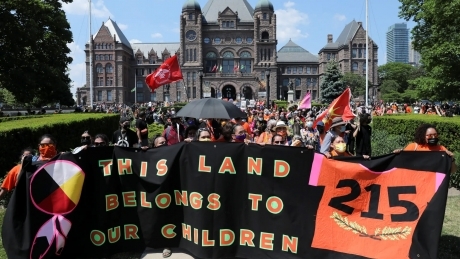
The Tk̓emlúps te Secwépemc First Nation got tired of waiting for action and commissioned their own study using GPR. In May 2021 Chief Roseanne Casimir announced that 215 (later amended to 200) potential unmarked graves had been found. This confirmed “a knowing” in the community about deaths and burials at the former Kamloops IRS site.
This announcement had a profound impact. Indigenous communities across Turtle Island commissioned further GPR studies and confirmed thousands of potential unmarked graves at former IRS and boarding school (similar institutions in the US) sites.
In response, many ceremonies were held honouring IRS survivors and the children who never made it back home, with those in attendance donning orange shirts emblazoned with “Every Child Matters”. People placed children’s shoes and teddy bears outside former schools, churches and at the base of statues of Egerton Ryerson and John A. MacDonald – many such statues of these IRS architects were vandalized, removed or torn down. Many thousands of people attended rallies and marches demanding justice, including on Canada day which became a sea of orange shirts instead of the usual patriotic red and white.
Racists and the “Mass Graves Hoax”
Crowds proudly waving Canadian flags emerged again at the so-called “Freedom Convoy” occupation of Ottawa in early 2022, a breakthrough for far right politics in Canada. While the mobilizations targeted pandemic mask and vaccine mandates, far right organizers also peddled anti-trans, anti-immigrant and racist ideas, included anti-Indigenous racism.
Various far right figures began claiming there was a “mass graves hoax” media conspiracy. C.P. Champion and Tom Flanagan published two books.
Both have long complained about the inroads that Indigenous voices have made in undermining the British colonial version of Canadian history. Flanagan was a close advisor to Stephen Harper and has written of his fears of solidarity in struggle between mass environmental movements and Indigenous land defenders.
The far-right asserts that the Tk̓emlúps te Secwépemc First Nation claimed that there were “mass graves” at the Kamloops IRS site and that the media “universally” reported this as truth. A report by the Centre for Human Rights Research at the University of Manitoba debunked this, the vast majority of articles reported the First Nation’s announcement accurately - as potential unmarked graves.
A small number of news articles used the phrase “mass graves” in their reporting, and this became a “conspiracy”.
The far right also asserts that GPR is unreliable for identifying human remains, accuses Indigenous peoples of covering up the lack of proof, and claims that residential schools were a positive experience for Indigenous children.
They aim to erase over 40 years of documentation of abuse and deaths at IRS schools, and the much longer knowledge of Indigenous peoples of this history. Various strains of the far right either say that the genocide did not occur or that it was justified.
Mainstreaming conspiracy
In May the Globe and Mail published an editorial, “No Reconciliation without Truth”, that accepts many of the far right talking points. They even berate their own reporting from 2021. While falling short of denying deaths and abuse at residential schools, they argue that the bodies must be dug up as proof, and that First Nations who refuse to do so are standing in the way of reconciliation.
Denying Indigenous oral histories has a long history in Canadian settler colonialism: for example, it has been used to enforce one-sided interpretations of treaties based on the documentation by colonial powers.
The editorial also ignores the many avenues being explored by Indigenous nations as they grapple with how to honour these children and their communities.
Bringing the children home
The process of honouring the IRS survivors and the children who never made it back home will be decided by the communities themselves. The Tk̓emlúps te Secwépemc First Nation is divided on whether to exhume the remains or leave them alone. In addition, many of the children who attended the Kamloops IRS came from other First Nations, complicating the situation.
May 25 was a Day of Reflection for the Tk̓emlúps te Secwépemc on the fifth anniversary of the GPR findings. On that day, Chief Roseanne Casimir delivered a message that said, in part:
“We are engaged in one of the most complex and sensitive investigations in this country’s history! Since 2021, we have made meaningful progress assembling trusted experts, analyzing extensive records, and working alongside communities to begin identifying children who never returned home.
“At the same time, we are navigating significant challenges, particularly in accessing records and archival data across multiple jurisdictions. These barriers have slowed progress, but they have not altered our commitment.
“Let me be clear, and it is important for me to share: This work is not about proving whether children died as we know this. This work is about who they were, where they are from, and returning them to their families with dignity.
“We continue to follow a careful, and evidence-based approach, guided by Secwépemc law, cultural protocols, and the voices of Survivors and families. This work will take time. It must be done properly.
“We also recognize that, at times, the truths of this history are questioned or minimized. We respond with clarity and resolve. The experiences of Survivors, the historical record, and the work underway stand on their own. Our responsibility is to continue forward with integrity, not to be drawn away from the work that honours the children and their families.”
All those seeking justice for historical and ongoing genocide against Indigenous people, must stand firm with the survivors. We must support the efforts of Indigenous communities to honour the memory of these children and the communities they were taken from. Narratives that undermine these efforts have to be exposed for the self serving, settler colonial mythologies that they are. Residential School denialism along with the rest of the lies of the far-right only benefit Canada’s 1% and act to defend the profits they gain from extractive capitalism.
We must seek justice for these past wrongs, but it is just as important to build active solidarity with the ongoing struggles of Indigenous peoples for justice and sovereignty.
Section:


Featured Event
Events
-
October 18, 2026TkarantoOrganized by:International Socialists
-
October 18, 2026TorontoOrganized by:International Socialists
Recent Videos


Visit our YouTube Channel for more videos:

Visit our UStream Channel for live videos: