
|
Reports
You are here
The streets call the shots: inside the popular uprising over housing in Spain
October 4, 2026
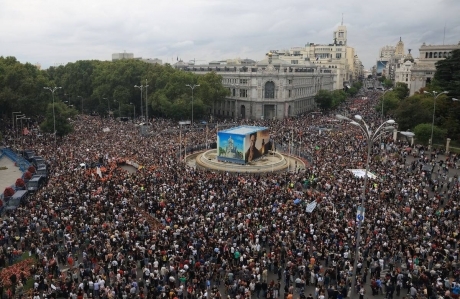
The images that have circulated in part of the media this past week, showing thousands of people occupying “Puerta del Sol,” Madrid’s city centre, may feel like a starting point, a breakthrough, the onset of a working-class battle. However, it is important for anyone who wants to see a shift in the balance of power in behalf of the working class to understand that the current occupation of city centres in more than twelve major Spanish cities has been the result of meticulous organizing work carried out over more than seven years by the Sindicato de Inquilinas e Inquilinos (Tenants’ Union). Seven years of organising regular neighbourhood assemblies for mutual support, in which the neighbours provide each other with advice and backing in their individual cases, whilst giving political meaning to their personal experiences and building genuine people’s power. This continues the practice initiated by the Plataforma de Afectados por la Hipoteca (PAH, Platform for People Affected by Mortgages) in the 2010s of calling on any neighbour to put their body on the line to prevent an eviction.
It is because of the well-established roots of the Tenants’ Union in Madrid’s neighbourhoods that, on the evening of September 22, hundreds of people once again responded to the call to take to the streets and spend the night outside the home of María del Carmen Abascal (Maricarmen), an 87-year-old woman with a 50% disability who was set to be evicted the following morning. The police closed off the street to prevent the even larger crowd that had turned up at dawn from joining the protest, even barring the press from covering the unfolding events. They then forcibly removed, one by one, the people who had flooded the street in front of the entrance, the stairs, and Maricarmen’s home, using a violence so blatant that had lost all semblance of legitimacy.
Maricarmen’s eviction is a paradigmatic example of the structural violence experienced first-hand by a large segment of society that cannot afford rent, that is forced to move more often and further and further from urban centres — which have now been transformed into tourist accommodations — cannot afford to move out of their parents’ homes, and is subject to landlord abuse. It is also the direct consequence of housing policies that have been far too lenient towards vulture funds, real estate agents and short-term rental platforms, and have privatised social housing and given landlords free rein to speculate, allowing them to raise rents at will with every lease renewal. During its current term, the left-wing coalition government has attempted, without much success and without sufficient political resolve, to counteract these policies, a legacy of previous PP (Partido Popular) administrations and current right-wing regional governments.
The outrage of a broad social majority, sparked by Maricarmen’s eviction, has spread beyond existing organisational structures and has exerted relentless pressure on the Government to compel it to pass a decree-law that was dubbed the ‘Maricarmen Decree’. The Tenants’ Union’s demands include the outlawing of evictions, restrictions on seasonal and room-by-room lettings, a general rent freeze and the automatic renewal of existing rental contracts, as well as the expropriation of properties held by vulture funds.
The squeeze on the administration from popular mobilization forced the Cabinet to pass two decree-laws on September 29, which took immediate effect. However, a good part of the measures in these decrees failed to address the root causes of structural inequality and avoided confronting the rentier class. Among the provisions were: preventing vulture funds from purchasing homes for less than 70% of their market value; tax relief for landlords who reduce rent prices; the increase in VAT on tourist rentals; a freeze on rents above average market rates, valid only until 2028; and a ban on evictions, effective only until 2031. These measures have struck the people on the streets as far from satisfactory and the government was suspected of splitting a single decree into two, foreseeing that the one including the boldest measures would fail to secure a parliamentary majority.
A parliamentary session needed for their ratification was scheduled on October 2 and, while it was expected that the most ambitious decree would not be approved, ultimately both decrees were rejected due to a lack of support from right-wing, centre-right, and pro-independentist parties. Square occupations, demonstrations, and popular assemblies are set to continue in full force and the Tenant’s Union and other voices are calling to a general strike. Prime Minister Pedro Sánchez, for his part, has announced that he is considering bringing forward general elections and that his decision will be made public on October 5.
Even if the left-wing parties do not have an assured victory according to polls, this movement, which like the 2011 Indignados movement has already expanded to claim other civil rights such as education or public health and question the distribution of wealth, is already being victorious when it comes to re-inspiring and convincing the public that politics is worth doing and can be done by everyone. As a case specific victory, the mobilizations have forced Madrid City Council and Urbagestión, the company that owns Maricarmen's home, negotiate her return home by signing an eight-year rental contract, under which she will pay a monthly rent not higher than 30% of her pension.
Nevertheless, the structural victory is that the organized working class has manage to shift the focus of public debate by addressing material living conditions and framing the issue as a conflict between housing as a right and business interests, between life and capital. In the occupied squares, political imagination is being broadened, and the prevailing common sense about what is politically feasible and desirable is being redefined. Many who previously lacked the language or the hope to channel their disillusionment, and who were adopting complacent, neoliberal, and individualistic stances, if not openly fascist ones, are now experiencing the most powerful of joys: collective struggle.
Section:
Topics:


Featured Event

Events
-
October 28, 2026VancouverOrganized by:snəw̓eyəɬ leləm̓ Langara International Socialists
-
November 1, 2026TkarantoOrganized by:International Socialists
-
November 1, 2026TorontoOrganized by:International Socialists
Recent Videos


Visit our YouTube Channel for more videos:

Visit our UStream Channel for live videos: