|
Features
You are here
Election 2026: Another Quebec is possible
October 6, 2026
Throughout the Quebec election campaign, the media in English Canada focussed on the possibility of a third referendum. Now that the Parti Québécois has formed a minority government with the Liberals in opposition, that future is unclear.
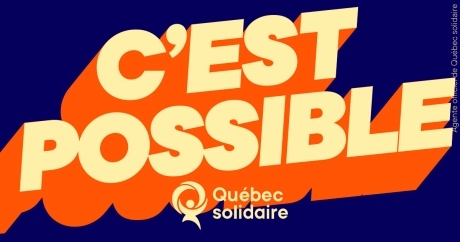
But the untold story of the election is the survival of Québec solidaire, the only party of the left, which fought a strongly progressive campaign against a rising tide of neoliberal austerity and racism. Its platform for climate justice and aggressively taxing the rich to pay for affordable housing and rent control, public healthcare and public transit, as well as NYC Mamdani-style public groceries, outshines the NDP in every way. The slogan was “It’s possible,” which was a breath of fresh air in a right-moving landscape.
QS was the only party to denounce the “ethnic” definition of what it means to be Quebecois today, to embrace immigration as enriching Quebecois identity, to support nation-to-nation sovereignty relations with Indigenous communities, and to denounce Islamophobia masquerading as “secularism.” QS punched up while every other party punched down.
And they emerged practically unscathed despite the odds, holding on to nine seats. In 2018 QS had made its first breakthrough, electing 10 MNAs and becoming recognized as the official “second opposition” to the ruling CAQ. It was bolstered by the youth generation of the Maple Spring student strike, which joined the party en masse. In 2022, QS carried that breakthrough forward, occupying a solid second place in the popular vote. It was an indication that though Quebec society was polarizing, it was not entirely to the right.
This time, QS did see a drop in its youth vote, but still 21% of its candidates in the 2026 election were 30 years old or younger. And this time, the popular vote was not a strong indicator of success, with five parties vying for it. The reviled incumbent Coalition Avenir Quebec (CAQ) got 13% of the popular vote but not a single seat, while QS got 12% of the popular vote and still secured its 9 seats. This is an indication of the solid roots QS has built; the PQ could not pull any QS strongholds.
“Party of the ballot and party of the street”
QS emerged out of social movements as a formal party in 2006. Its pledge was to be a voice of social justice movements in the National Assembly and to “do politics differently” to avoid the pitfalls of just chasing votes. It painstakingly built a coalition between social democrats (orphaned by the collapse of the provincial NDP over its federalism) with the left of the women’s movement, the strong climate justice movement in Quebec, rank and file union activists, and the left of the sovereigntist movement.
As an electoral party, for twelve years it struggled on the margins to win over the base of support of the Parti Québécois. The PQ had been the unofficial party of the left and labour movement since the 1970s: today it is hard to imagine that they had ever tried to pose as social democrats. They were always a split from the Liberals, but they needed to build a base amongst the most impoverished Quebecois and connect with the growing power of the labour movement in the 1970s. The PQ was forced to integrate workers’ demands into its mandate, including the best labour laws and the only anti-scab legislation of the time.
Today the PQ has gone along with the pro-employer laws passed by the CAQ, some of the worst strike-breaking and union-busting laws in the country. In this context, QS’s call to tax the top 0.1% of earners with assets over $25 million to generate $5 billion annually for public services struck a chord.
“Identity” politics and sovereignty
From the 1990s, the PQ and other mainstream Quebec parties increasingly pursued an “ethnic” notion of Quebec identity that became increasingly racist. This was in lockstep with their embrace of neoliberalism and austerity. The false “secularism” promoted as a feature of Quebec identity by the CAQ, with its Islamophobic laws on religious symbols, had its roots in the PQ’s own “Values Charter” before that. And today every party but QS has jumped on the anti-immigrant bandwagon.
QS was also the only party that advanced a vision of Quebec independence not to build a nation for its own sake, but to break with the current order and imagine a radically different Quebec for the people, not the elite, to be achieved through a nation-to-nation relationship with Indigenous communities and rooted in equal respect for Indigenous sovereignty.
The PQ on the other hand said it would only “consult” Indigenous people in its sovereignty project. So on election night, Indigenous organizations and activists invited themselves to the PQ watch-party: they protested outside with the clear message of “pas sans nous,” “not without us.”
In her concession speech CAQ leader Christine Fréchette talked about the importance of the “third way” option her party offered: neither federalism nor separatism. The CAQ was a right-wing coalition of both camps, and ultimately represented nothing but a degradation of French language legislation into anti-immigrant racism.
After the ballot
Ultimately social change doesn’t happen at the ballot box. But QS ran candidates in all 127 ridings, not to win but to be seen. Building on that will now be key, to ensure QS is seen as part of real struggles for change.
Former QS MLA Françoise David told a reporter on election night that she hopes that QS works with all the most left forces in Quebec against the rise of the right. Ruba Ghazal, QS co-spokesperson of Palestinian origin, who was re-elected in her Montreal riding told a cheering crowd on election night that she was proud of the results that proved wrong those who said the opening for the left had closed in Quebec.
As Ruba said: “It’s a good thing Québec solidaire is here to be the voice of those who don’t have one. We resisted. We are standing tall. That’s also what Québec solidaire is: Québec solidaire is people who stand tall, who resist through thick and thin. We fought the way only the left knows how to fight.”
Section:


Featured Event
Events
-
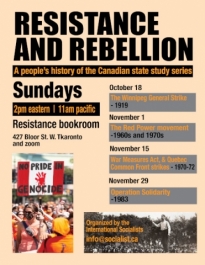
October 18, 2026TkarantoOrganized by:International Socialists
Recent Videos


Visit our YouTube Channel for more videos:

Visit our UStream Channel for live videos: