
|
Features
You are here
From Belgrade to Brazil, how to defeat the far-right at the ballot box and on the street
October 27, 2026
Two historic victories on the same day, in Serbia and Brazil, have opened a breach in the wall of authoritarianism and the far-right. These victories are part of a worldwide wave of revolt from India to France against the ruling class.
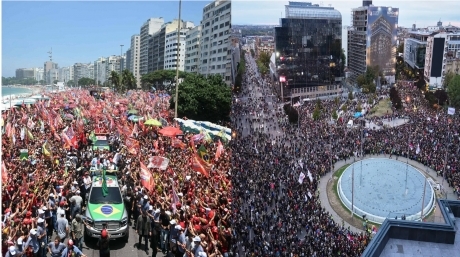
On October 25, 2026, the world witnessed two significant political victories against the right. In Serbia, a student-led popular movement inflicted a historic electoral defeat on Aleksandar Vučić and his right-wing party after fourteen years of political dominance. On the same day, Lula da Silva secured another presidential term in Brazil, defeating Flávio Bolsonaro, the far-right candidate and son of former president Jair Bolsonaro.
But for revolutionary socialists, the decisive question is not simply how to defeat the right at the ballot box. It is how to transform popular anger into an organized social force capable of uprooting the class relations that allow the right to rise.
These results do not mean that the wave of far-right politics sweeping across much of the world has necessarily begun to recede. But they reveal something profoundly important: the rise of the right is not historically inevitable, nor is its power unbreakable. Above all, they demonstrate that mass movements can overcome fear and disillusionment and rebuild confidence that people can bring about change and open up political possibilities that seemed unimaginable only a few years ago.
The Serbian experience is particularly significant because it did not begin with parliamentary maneuvers or the emergence of a new political leader. It began with a student movement that spread from universities into streets, towns, and villages, drawing in workers, farmers, teachers, and broad sections of society.
From a railway station tragedy to the fall of a political regime
On November 1, 2024, a concrete canopy collapsed at a railway station in Novi Sad, killing 16 people. The disaster quickly became more than a tragic accident. It became a symbol of political corruption and the intertwining of state power with the interests of business and contractors.
Students did not see the collapse as merely an engineering or administrative failure. They saw it as an expression of a system that prioritizes business deals, profits, and political connections over human safety.
The protests began with demands to expose and hold those responsible accountable, but soon developed into a mass movement challenging the entire regime.
Students occupied campuses, organized open assemblies, blocked roads and bridges, and marched hundreds of kilometres between towns and villages. Universities became centres for organizing resistance, while a new social force emerged in the streets.
The decisive breakthrough came when students succeeded in breaking down the barriers separating universities from wider society. No longer simply a protest by educated young people, the struggle became an expression of broader anger against corruption, authoritarianism, and social injustice.
By the time of the parliamentary elections on October 25, 2026, the Students’ List was no ordinary electoral challenge: it was the political expression of a popular movement that had developed over nearly two years.
According to preliminary results announced by Vučić himself, the student-backed list won around 2.2 million votes, compared with 1.7 million for his camp, and was projected to secure between 135 and 140 seats in the 250-member parliament.
The scenes in Belgrade were extraordinary. Chanting crowds poured into the streets to celebrate the defeat of a man who had ruled the country with an authoritarian grip, announcing the end of an entire political era.
This victory was not created on election day, but forged through hundreds of days of organizing, confrontation, and determination.
Corruption is more than a moral failure: the class roots of the crisis
For revolutionary socialists, Vučić’s rule cannot be adequately explained by personal authoritarianism or the corruption of individual officials.
These features were rooted in an economic and social structure characterized by close ties between political power and capital, the attraction of investment through cheap labour, government subsidies to corporations, and the weakening of workers’ ability to defend their interests.
This did not begin with Vučić. Since the breakup of Yugoslavia and the transformation that followed the fall of Slobodan Milošević in 2000, large sections of Serbia’s working class have suffered the consequences of privatization, economic restructuring, and the erosion of social protections.
Vučić benefited from these transformations, deepened aspects of them, and tied the administration of the state to networks of political and economic loyalty.
This is the class significance of the Novi Sad tragedy: when infrastructure projects are governed by business deals and relationships between the state and capital, people's lives and safety become secondary considerations.
Of course, this does not mean that every industrial disaster is directly caused by capitalism, or that criminal responsibility for the station collapse has already been established.
But the disaster exposed a broader crisis concerning who determines investment priorities, who oversees public projects, and who holds powerful interests accountable.
This means corruption is more than a moral issue. It is one of the ways class power manifests itself within the state.
Replacing corrupt officials with honest ones, however important, will not by itself end the exploitation of workers and the prioritization of investors’ interests over social needs.
Students ignite the spark, but workers hold the power to transform society
One of the most important lessons of the Serbian experience is the revolutionary potential of student movements.
Because students are concentrated in universities and have the capacity to communicate and organize rapidly, they can move quickly, break through fear, and launch broad political initiatives. Large numbers also face a future marked by precarious employment, rising living costs, difficulties accessing housing, and economic insecurity. They are not as affected by past defeats - unlike older generations - that can hinder taking action.
But students do not constitute a single social class, nor do they alone possess the power to halt production and reorganize the economy.
This is where the strategic importance of the working class becomes clear.
The Serbian movement revealed the enormous potential of an alliance between students and workers. Teachers took strike action, workers and public employees supported the protests, farmers brought their tractors onto the streets, taxi drivers assisted demonstrators, and numerous professional and social groups joined the mobilizations.
On January 24, 2025, Serbia witnessed a day of civil disobedience and work stoppages in response to calls for a general strike, with participation from trade union, professional, and student groups.
While significant, it did not develop into a sustained general strike capable of shutting down the main sectors of the economy. This is not a minor observation but a strategic question.
As revolutionary socialists in the tradition of Tony Cliff have argued, the historical power of the working class comes not from being the poorest or most oppressed section of society, but from its position within the process of production and social reproduction.
Students can shut down universities and roads, and demonstrations can mobilize hundreds of thousands. But mass strikes in industry, energy, transport, and public services can directly attack the sources of profit and economic power on which the system depends.
More importantly, workers’ power can not only disrupt the old society but can organize a new one based on democratic control over production and services.
The challenge ahead in Serbia is therefore to move beyond solidarity between students and workers towards building permanent organizations in workplaces, neighbourhoods, and universities that connect the democratic struggle with economic and social demands.
Democracy from below or a new government from above?
One of the defining features of the Serbian movement has been the centrality of student general assemblies, where decisions are made through discussion and direct voting rather than being imposed by a centralized individual leadership.
This has been one of the movement’s greatest strengths.
It made the movement less vulnerable to co-option by traditional opposition parties, and harder for the regime to target or discredit its leaders. It also allowed thousands of young people to gain direct experience in organization, solidarity, and collective decision-making.
But the transition from the streets to parliament raises a new contradiction.
The student-backed electoral list does not include students among its candidates. Instead, it brings together relatively unknown figures from different professional backgrounds, including academics, doctors, experts, artists, and activists.
This raises a fundamental question: who will determine the political direction of the new government? Will student assemblies and the popular movement continue to exercise decisive influence, or will real power pass into the hands of MPs, ministers, and experts?
This is not merely a procedural issue.
Parliament operates within an already existing state, with its security institutions, judiciary, and bureaucracy, and within an economy in which domestic and international capitalist interests control substantial resources.
Representatives of a popular movement may enter government, only to find themselves under immediate pressure from investors, financial institutions, state bureaucracies, and international commitments.
Without continued mass mobilization, a government brought to power by a popular uprising may become little more than a new administrator of the old social order.
Revolutionary socialists do not reject elections or underestimate the importance of electoral victories. But we do distinguish between winning governmental office and transforming the balance of class power within society.
Elections can remove a government, but only independent mass organization can impose profound social change.
Does the students’ list offer an alternative class programme?
It would be wrong to reduce the Students’ List programme to demands for honesty and an end to corruption.
Their programme contains concrete labour and social reforms, including reducing the maximum duration of temporary employment contracts from 24 to 12 months, strengthening protections for seasonal and agency workers, linking the minimum wage to the actual cost of living, strengthening trade unions and the right to strike, and improving workplace health and safety inspections.
It also opposes Rio Tinto’s lithium mining project in the Jadar Valley and calls for the protection of natural resources and local communities.
These are important demands that could provide the basis for genuine improvements in workers’ lives.
But it is not yet a socialist project aimed at overcoming capitalism. It combines social reforms with an emphasis on expertise, investment, productivity, and private enterprise.
This presents a central challenge for the revolutionary left: how can it support reforms that benefit workers while also fighting to move beyond their limitations?
Socialists should neither stand outside the movement because it is not socialist nor dissolve themselves into it and surrender their political independence.
The task is to participate in its struggles, defend its gains, and build connections between the demands for democracy, workers’ rights, and popular control over wealth and resources.
Without independent working-class organization, even the most progressive reforms can be rolled back when they encounter resistance from employers and capital.
From Serbia to Brazil: is the far-right beginning to retreat?
Vučić’s defeat takes on greater significance when viewed in the context of international political developments.
In Brazil, the same day saw Lula da Silva defeat Flávio Bolsonaro in the second round of the presidential election, winning 51.79 percent of valid votes against 48.21 percent for his opponent.
The popular mobilization that swept Brazil between the two rounds of the presidential election was one of the most important factors behind Lula’s victory over the far-right. After Flávio Bolsonaro finished ahead in the first round, a broad wave of mobilization emerged, led by students, young people, trade unions, and social movements, spreading from the streets, universities, and workplaces to social media. What distinguished this mobilization was that it went beyond a conventional electoral campaign. It involved grassroots initiatives that, at times, extended beyond traditional party structures, transforming the fear of a return of Bolsonarism into a collective force of organization and resistance.
From a revolutionary socialist perspective, the significance of this experience lies in its demonstration, once again, of the power of popular mobilization to shift the political balance of forces. At the same time, it raises a crucial question about the future of this energy after the elections. Despite its defeat, the far-right still commands an enormous electoral base of nearly 60 million voters, alongside considerable influence within state institutions and Congress.
More dangerously, Bolsonaro refused to acknowledge his defeat and demanded that the results be annulled.
While It has lost a major electoral battle, the Brazilian far-right still possesses a mass social and organizational base capable of fighting further battles.The real challenge, therefore, is not simply to defend the electoral victory but to transform this mobilization into an independent mass movement rooted in the working class, capable of winning meaningful social reforms, confronting austerity and exploitation, and preventing the far-right from returning to power.
History teaches us that defeating the right at the ballot box does not necessarily mean defeating it in society and that the real strength of the left lies in its ability to organize workers and the oppressed, rather than simply in winning governmental office.
In April 2026, the far-right government of Viktor Orbán was defeated in Hungary after sixteen years in power. Yet there is an important contradiction: Orbán was defeated, not by a socialist movement but a conservative, pro-European political force.
These victories are therefore not all evidence of a rising left.
What they have shown is the weakening of some authoritarian right-wing regimes’ ability to maintain their dominance, alongside a growing popular willingness to resist them.
But the political direction of that resistance remains unresolved.
It could develop into a movement for social democracy, equality, and workers’ rights. It could be contained within the limits of moderate liberal reform. Or subsequent disappointment could pave the way for the far-right to return in an even more dangerous form.
The far right is more than an electoral phenomenon
It is important to distinguish between the conservative right, right-wing authoritarianism, and fascist movements.
Not every right-wing government is fascist, and the downfall of an authoritarian leader does not mean the destruction of the social and political forces that supported them.
But this does not diminish the danger of a global trend in which far-right movements have used aggressive nationalism, racism, attacks on migrants and minorities, and hostility towards the left and trade unions to reshape politics in the interests of the ruling classes.
For Marxists, this rise cannot be separated from capitalism’s recurring crises.
When living standards fall, employment becomes increasingly precarious, the housing crisis deepens, and millions lose confidence in traditional political parties, far-right forces can offer reactionary explanations for these crises. They redirect anger away from employers and capitalist policies and towards migrants, minorities, and the most oppressed sections of society.
This is one of the central political functions of the far-right: dividing the working class along national, racial, and religious lines, thereby weakening its ability to confront capital as a united force.
This does not mean that everyone who votes for the far-right fully supports its political project. Many may be motivated by anger, frustration, or a sense of marginalization. But the right's ability to exploit such anger grows when the left fails to offer a convincing alternative.
That is why the fight against fascism cannot be reduced to defending existing democratic institutions, however important democratic rights may be.
It also requires struggles for wages, housing, and public services, resistance to racism, and the building of working-class solidarity across national and religious divisions.
Serbia offers an important lesson in this respect: a broad mass movement can overcome fear and unite diverse social groups against an authoritarian regime. But it must also confront conservative nationalist currents within society and the movement itself, including those relating to minority rights and the national question in Kosovo.
Liberation from authoritarianism cannot be complete if it reproduces other forms of national or social oppression.
Between Moscow, Brussels, and Washington: independence from Imperialist blocs
Vučić attempted to portray the student movement as a foreign-led conspiracy aimed at overthrowing his government.
But this accusation ignores the deep social roots of the protests and the fact that the movement emerged from widespread popular anger against corruption and repression.
Meanwhile, European Union leaders welcomed the students’ victory and offered support for democratic reforms and closer European integration.
Revolutionary socialists should not be forced to choose between these rival camps.
Defending the independence of Serbia’s popular movement does not mean supporting Vučić because of his ties to Russia. Nor does opposition to authoritarianism mean giving the European Union or the United States a mandate to determine the country’s future.
The Serbian working class does not share the same interests as the ruling elites in Moscow, Brussels, or Washington.
The major capitalist powers compete over markets, resources, investment, and geopolitical influence, while workers pay the price for this competition.
A genuine internationalist position begins with solidarity with workers and young people fighting for democracy and social justice, while rejecting the subordination of their struggle to the interests of any imperialist power.
What comes after victory?
The real test of the Serbian movement begins now.
The task is not simply holding those responsible for corruption and repression accountable but transforming the mass energy of the movement into a force capable of defending the interests of the overwhelming majority.
This means maintaining and expanding democratic student assemblies, building independent committees in workplaces and neighborhoods, strengthening trade unions’ ability to organize and strike, and connecting democratic demands with struggles over wages, housing, healthcare, education, and environmental protection.
It also means refusing to allow the movement to become merely an electoral base, mobilized every few years to vote while fundamental decisions are left to ministers and experts.
As social reforms encounter resistance from investors or the institutions of the state, the new government's ability to advance will depend heavily on continuing student and community mobilizations - and workers’ struggles - outside parliament.
In Brazil, Lula faces a similar challenge, although in a different political context. Defeating Bolsonaro electorally will not be enough if the far-right remains capable of exploiting social crises and declining living standards.
Confronting this danger requires mobilizing trade unions, social movements, Black and Indigenous movements, young people, and women, while defending and expanding social reforms against capitalist pressure.
It is also essential that parliamentary alliances with conservative forces do not become a permanent substitute for building independent mass power.
Hope is not waiting for the future, but organizing the power to create It
Two years ago, few could have imagined that the collapse of a concrete railway station canopy would spark a student movement that would end fourteen years of Vučić’s rule.
Only weeks ago, a victory for Flávio Bolsonaro in Brazil seemed almost inevitable after he came first in the opening round of voting.
But both events revealed that political balances of power are not fixed, and that authoritarian and far-right forces can suffer major defeats.
This is one of the most important truths that the revolutionary left must reclaim today, applicable to struggles that are exploding across the planet today from India to France and many other places besides.
Capitalism produces not only exploitation, oppression, and crises, but also resistance. Those subjected to its attacks are not simply passive victims. They possess the capacity to organize, build solidarity, and change the course of history.
But there is no guarantee that this resistance will automatically develop in a socialist direction.
The struggle remains open between competing political directions: one that seeks to restore liberal democracy without changing class relations; a right-wing attempting to rebuild its influence; and a revolutionary socialist current that understands genuine liberation requires overcoming the system that produces exploitation, inequality, and authoritarianism.
This is why building revolutionary socialist organizations rooted in the working class is so important. Such organizations must be capable of intervening in mass movements and bringing different struggles together into a broader political fight against capitalism.
The greatest achievement of Serbia’s students is not simply that they defeated a ruling party. It is that they demonstrated how ordinary people, when they organize collectively, can overcome a power that once appeared unshakable.
From Belgrade to Brasília, popular victories are opening the door to a new period of struggle. But the defeat of the far-right will become truly historic only when it moves beyond changing governments to transforming the balance of power between classes.
The future is not made at the ballot box alone. It is made by millions of people organizing, striking, demonstrating, and building solidarity.
Serbia’s students have shown that the right can be defeated. Now begins the more important battle: turning that defeat into a lasting victory for workers and the oppressed and transforming hope from a collective feeling into an organized force capable of changing the world.
Section:


Featured Event

Events
-
October 28, 2026VancouverOrganized by:snəw̓eyəɬ leləm̓ Langara International Socialists
-
November 1, 2026TkarantoOrganized by:International Socialists
-
November 1, 2026TorontoOrganized by:International Socialists
Recent Videos


Visit our YouTube Channel for more videos:

Visit our UStream Channel for live videos: