|
You are here
The War Measures Act & Quebec Common Front Strikes of 1970 -72
Location
Resistance book room and on zoom
427 Bloor St W.
Tkaranto
, ON
Canada
See map: Google Maps
Ontario CA
War Measures Act & Quebec Common Front Strikes – 1970 -72
Sunday November 15 - 2pm eastern | 12pm pacific
Resistance Bookroom
427 Bloor St W. Tkaranto and on zoom
Quebec public sector negotiations in 1968-1970 with the Quebec government made it clear that only unity could defeat the employer strategy to stall with the strongest groups so that the weakest groups of workers were forced to set the pattern for all. In January 1970 representatives of all federations and unions of the public and broader public sector convened to set up a Common Front.
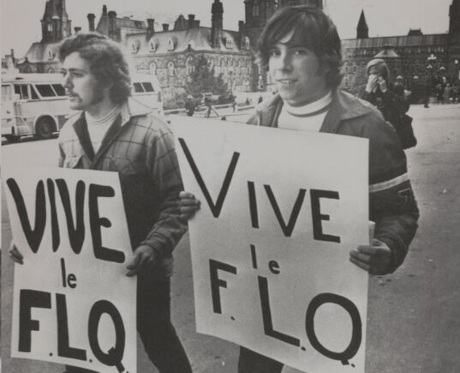
Then, in October 1970, the armed occupation of Quebec by the federal Canadian state played a role in pushing the need for unity between unions even further. Ottawa had invoked the War Measures Act, which suspended civil liberties, supposedly in response to the kidnapping of two political officials by the Front de Libération du Québec (FLQ). But in fact, thousands of ordinary Quebecois were surveilled and arrested, and union activists and leftists were especially targeted.
Meanwhile, throughout 1970 and 1971, the union rank and file membership was extremely active: not only strikes but street blockades, riots and demonstrations were everywhere in Quebec in 1970-71. But the most historic was in April and May of 1972: what had started as a legal public sector strike became a raging wildcat strike that spread to the private sector and led to the takeover of 9 towns, including radio stations and newspapers.
The paper L’Avenir was owned by Canadian media boss Conrad Black, then a young millionaire who owned several Quebec papers. He woke up one morning to a panicked phone call from his publisher in Sept-Iles, a small remote Quebec town. “They’re taking over the paper, they’re seizing control!” Suddenly, a new voice came on the line informing Black that his anti-union paper was about to be dismantled. Black shouted into the phone: “Comrade, be reasonable.” Finally, the workers’ committee agreed not to dismantle the plant.
This is a story about how a new Quebec working class rose up against both its oppression as a nation within the federalist Canadian state and against its own capitalist employers. And had a real moment of trying to run things differently, for and by themselves, under workers' control. The slogan? “We can only count on ourselves.”
Suggested reading
Fifty years since the “October Crisis”: a not-so-quiet Revolution by Chantal Sundaram
Part of
Resistance and rebellion: A people’s history of the Canadian state study series
Dates:
Sunday, November 15, 2026 - 17:00
Organized by:
International Socialists


Featured Event

Events
-
November 1, 2026TkarantoOrganized by:International Socialists
-
November 1, 2026TorontoOrganized by:International Socialists
-
November 15, 2026TkarantoOrganized by:International Socialists
Recent Videos


Visit our YouTube Channel for more videos:

Visit our UStream Channel for live videos: