
|
Arts
You are here
American Socialist: The Life and Legacy of Eugene V Debs
November 10, 2026
Review: The Life and Legacy of Eugene V Debs by Shawn Gude
Shawn Gude’s comprehensive and accessible biography of Debs on the 100th anniversary of his death is important and timely as socialism returns to mainstream politics in the US. The parallel of the debates and pitfalls for socialists between Debs’ time and now is striking.
Gude captures Debs’ humility, his commitment to workers and his tireless campaigning for socialism throughout his life. Gude also recovers the history of the flourishing of socialist ideas and the success of the Socialist Party of America (SPA) that Debs founded. He particularly highlights that its strongholds were in the Midwest, in states like Oklahoma, Kansas, Indiana, Iowa and Wisconsin, the Trump supporting ‘red’ states today.
Debs’ legacy has survived the attempt to write him out of US history books. He is regularly quoted, including by Zohran Mamdani and Bernie Sanders. Both are part of the largest socialist formation today, the Democratic Socialists of America (DSA), which traces its lineage to Debs’ SPA. But the DSA has taken a very different path from Debs’ party.
Born in 1855, Debs lived through the period of massive industrial development of US capitalism post-Civil War and the rise of a US working class that would struggle against it.
The first mass strike waves by US workers occurred during this period of unbridled capitalist expansion. It was also a period of mass migration. German and Irish workers fleeing political upheaval and famine, Russian and Eastern European Jews fleeing pogroms and the ‘Great Migration’ of black workers from the south to the burgeoning industries of the North.
Some of these immigrants brought and promoted socialist and Marxist ideas that would deeply influence Debs.
Debs was born and would live almost his whole life in Terre Haute, Indiana, a small city that was one of the gateways to western expansion. Debs went to work for the railroad at 14 and was appalled by conditions for workers. By the age of 22, motivated by his Christian values, Debs felt called to trade unionism and to politics.
Strike leader to socialist
Gude tracks Debs’ two political journeys. His first journey was a long and somewhat tortured journey from a strike-averse craft union leader preaching collaboration with the boss to a working-class fighter leading strikes against the robber barons. After a stint as an elected Democrat, he condemned both political parties for acting only in the interests of capital and not workers.
His second journey was from working class consciousness to socialism as he could see no way forward for workers under capitalism. He also recognized the need for a party that could be the political expression of workers ‘struggles and founded the Socialist Party of America (SPA).
In 1894 as leader of the American Railway Union, Debs led a national strike against the powerful Pullman Car company. The company tried to break the strike with Pinkerton thugs and government collusion. Debs was thrown in jail for defying an injunction.
Debs’ national reputation as a class-conscious fighter was boosted by the Pullman strike. He was visited in jail by many activists and socialists, including Victor Berger, an Austrian immigrant building a socialist stronghold in Milwaukee, Wisconsin. Berger would be a founder of the Socialist Party of America with Debs. Berger gave Debs a copy of Marx’ Capital.
Debs read it and other socialist texts during his jail stint.
Soon after leaving jail, he declared himself a socialist saying, “The issue is socialism vs. capitalism. I am for socialism because I am for humanity.”
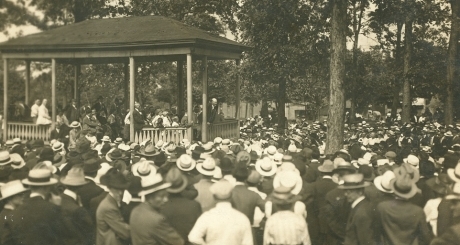
Gude describes Debs’ zeal as a campaigner for socialism across the country even as his own ideas about socialism were developing. He was a passionate and fiery orator and traveled tirelessly to speak to workers: miners in the West, farmers in the prairies and industrial workers in the Midwest. His touchstone for the rest of his political life was workers and their interests.
Socialist Party of America
Debs considered, then discarded, different ideas of socialism: among them Christian socialism (although he remained a Christian) and agrarian socialism. Debs decided to join with the Marxists connected to Berger to form the Socialist Party of America (SPA) In1901. The founding conference was held in Indianapolis, Indiana.
The SPA called themselves ‘international socialists’ and associated ideologically with the Marxist Second International, where the German Social Democratic Party (SPD) and other European socialist parties were on the rise.
The SPA was also anti-imperialist in the face of rising US imperialism. Debs and SPA supported Mexican revolutionaries when Woodrow Wilson sent in US troops to put down rebellion in support of US corporate interests during the 1910-1920 Mexican Revolution.
The SPA would be thrust into many crucial debates and struggles in the early decades of the 20th century that would sometimes divide the party: women’s suffrage, the rising anti-Black racism of Jim Crow, the syndicalism of the IWW vs. socialism. Gude notes that Debs usually took a left perspective but was not always ready or willing to defend his views in party debates.
The SPA would reach its highest point of influence in the 1912 elections as a third party winning 1000 local elections, 80 mayorships, and one Congressional seat. Socialists led several American Federation of Labor (AFL) unions and state federations of labour. Gude shows how it was a remarkable achievement of local organizing. The socialist press pumped out 2 million copies of English and foreign language papers every week, distributed by thousands of SPA members across the country.
War and Revolution
A defining moment for Debs and the SPA was their condemnation of World War 1, which the US would not join until 1917. When the US joined the war and criminalized dissent, Debs, Berger and others would land in jail. Debs ran for president for the fifth and last time from a jail cell, receiving nearly a million votes.
The other event that rocked the SPA was the 1917 Russian Revolution, the first successful workers’ revolution. It was hugely inspiring to socialists around the world. Many socialists would form Communist parties based on the Bolshevik model. Debs declared himself a Bolshevik and supporter of the revolution.
It would also produce a crisis for the SPA. Two Communist parties were formed in the US and many SPA members left to join them. A left faction, mainly of younger members, pushed the SPA to move left. The left faction was expelled by Berger and the right-wing of the party, purging 70,000 members. These faction fights occurred as the heavy repression from bosses and the Wilson government targeted the IWW, socialists and communists and further weakened the SPA.
In jail from 1918, Debs was distant from much of the strife. He was released from jail in 1921 suffering increasing ill health. Although Debs stayed in the SPA the rest of his life, he no longer played a leadership role and died in 1926. The broken SPA would continue in a reformist direction and not play a significant role in US politics.
Gude’s book does the wonderful service of restoring the history of Debs and the SPA to a new generation—a generation once again looking to socialism in the face of the multiple crises of capitalism— destroying the planet, waging war and immiseration of people's lives. But readers will need to look elsewhere for an analysis of the lessons that Debs and the SPA can offer to socialists today.
Shawn Gude is a former Jacobin editor.
Section:


Featured Event

Events
-
November 15, 2026TkarantoOrganized by:International Socialists
-
November 15, 2026TkarantoOrganized by:International Socialists
Recent Videos


Visit our YouTube Channel for more videos:

Visit our UStream Channel for live videos: