
|
Features
You are here
Gaza, the Rohingya, and the architecture of genocide
November 23, 2026
The International Court of Justice (ICJ) ruling on Myanmar exposes the machinery of racism, dispossession, and imperialist power—and the struggle for everything that cannot be bought or erased.
This historic ruling raises a question that reaches from Arakan to Palestine: who builds the machinery of genocide, who keeps it running, and what will it take to stop it?
There is something unbearably cruel about a world in which a child can be murdered before learning to speak, while the court that eventually recognizes the crime takes nine years to deliver its judgment.
Hasina was just six months old when Myanmar soldiers threw her into a river. Her father, Zahir Ahmed, watched as troops opened fire on the people of his village, Tula Toli, and hurled children into the water. He survived, carrying the memory of his wife and children dying before his eyes.
On 19 November 2026, the International Court of Justice finally ruled that Myanmar had committed genocide against the Rohingya during the military operations that devastated northern Arakan, also known as Rakhine State, in 2017.
More than 10,000 people were killed. Entire villages were burned, women were subjected to sexual violence, and hundreds of thousands were driven from their homes. More than a million Rohingya remain in refugee camps in Bangladesh.
But the judgment cannot bring Hasina back. Nor can it restore the villages reduced to ashes or give back the childhoods stolen in exile.
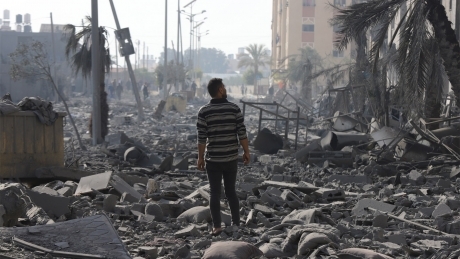
Thousands of kilometers away, in Gaza, Palestinians confront their own catastrophe of mass killing, displacement, and the destruction of the conditions necessary for life.
According to figures reported by the United Nations, more than 74,000 Palestinians had been killed since October 2023 by 18 November 2026.
And yet the question is not simply why so many have died. It is why a political and economic order that claims to defend human rights continues to make such destruction possible.
The Palestinian poet Mahmoud Darwish (1941–2008), one of the towering figures of modern Arabic literature, transformed the experience of Palestinian dispossession into poetry of extraordinary human depth. His work speaks not only of exile and resistance, but of the stubborn beauty of ordinary life.
In his celebrated poem On This Earth There Is What Deserves Life, he declares:
“On this earth, there is what deserves life.”
The poem does not begin with armies, borders, or declarations of war. It begins with life itself.
April hesitates at the threshold of spring. The scent of freshly baked bread rises into the morning air. There is the trembling wonder of first love and mothers who seem to balance upon a single thread of flute music. There are memories that terrify conquerors, because they cannot be erased by the conquest of territory.
These are not trivial pleasures. They are the substance of human existence.
And this is precisely what genocide attacks.
It destroys not only human bodies but also the relationships, memories, landscapes, and everyday possibilities through which human beings give meaning to their lives.
A village is not merely a collection of houses. It is where generations have loved, labored, buried their dead, and imagined their children's futures.
To burn that village is to attempt to destroy a piece of human history.
Genocide begins long before the killing
The genocide of the Rohingya did not begin in August 2017. The massacres were the culmination of decades of organised racism, legal exclusion and the systematic denial of an entire community's humanity.
The roots of modern persecution stretch back to British colonial rule, which exploited ethnic and religious divisions to maintain control over Burma, as Myanmar was then known.
After independence in 1948, sections of the nationalist ruling elite reproduced these divisions within the new state.
In 1982, Myanmar introduced a citizenship law that excluded most Rohingya from citizenship. People whose families had lived in the region for generations were transformed into foreigners in their own homeland, deprived of freedom of movement and fundamental rights.
This was not simply bureaucratic discrimination. It was a political process that prepared the ground for mass violence.
When a state denies a community's belonging, portrays it as an alien presence and repeatedly identifies it as a threat to national security, the possibility of expelling or destroying that community can gradually become an acceptable part of official politics.
In 2017, Myanmar's military justified its offensive as a response to attacks by Rohingya insurgents. But its operations involved the systematic burning of villages, the killing of civilians and the pursuit of fleeing families.
Racism was not merely an unfortunate prejudice held by individual soldiers. It had become an instrument of state power.
Behind that power stood a military establishment deeply entangled with the economy, controlling businesses, property and networks of privilege. The defence of military rule was inseparable from the defence of material interests.
In Palestine, the historical origins of dispossession are different. Zionist settler colonialism, supported by imperial powers, led to the Nakba of 1948, when around 750,000 Palestinians were expelled or fled from their homes.
Yet the two histories reveal a shared political mechanism: a population is portrayed as an obstacle to the state's project, and violence is deployed to reshape the land and its inhabitants.
The Rohingya were denied citizenship and portrayed as outsiders. Palestinians have endured successive forms of displacement, occupation and dispossession, with millions denied the right to return to their homes.
The violence is directed not only against people, but also against the possibility of their continued collective existence.
Ibtisam, a Palestinian woman from Gaza, told Socialist Worker how her grandparents never stopped mourning Qastina, the village from which they had been displaced in 1948. They had found refuge in Gaza, but their lost village remained alive in their memories.
Then another generation was forced to flee.
The catastrophe of Palestine is that exile has become an inheritance. Children and grandchildren are displaced from the very places where their grandparents once sought refuge.
Darwish understood this relationship between memory and power. His poetry returns again and again to the human capacity to remember a homeland that political authority attempts to remove from history.
In On This Earth There Is What Deserves Life, the conqueror fears memory itself.
For a people who remember cannot be entirely erased.
Who keeps the machinery of genocide running?
In September 2025, the United Nations Independent International Commission of Inquiry concluded that Israel had committed genocide against Palestinians in Gaza, based on its examination of the acts committed and evidence of genocidal intent. Israel rejects the accusation and maintains that its military operations target Hamas.
South Africa's genocide case against Israel remains before the International Court of Justice, which has not yet delivered a final judgment.
Meanwhile, the International Criminal Court issued arrest warrants in November 2024 for Israeli prime minister Benjamin Netanyahu and former defence minister Yoav Gallant over alleged war crimes and crimes against humanity, including the use of starvation as a method of warfare.
The judgment against Myanmar carries significance for the proceedings concerning Gaza. The International Court of Justice has made clear that a declared objective of combating insurgency, or even an intention to expel a population, does not necessarily exclude a simultaneous intention to destroy that population.
But the deeper question extends beyond the courtroom.
How can governments carry out atrocities on such a scale while powerful states continue to supply weapons, provide diplomatic protection or restrict themselves to expressions of concern?
Genocide is not simply the consequence of individual cruelty or the madness of particular rulers. It requires institutions, armies, money, weapons, ideologies and political alliances.
Myanmar's generals benefited from military and economic relationships with foreign powers, including China and Russia. Israel, meanwhile, occupies a strategic position in the United States' military and political dominance of the Middle East.
American military assistance to Israel runs into billions of dollars annually. The continuation of the war cannot be separated from that material and diplomatic support.
From a Marxist perspective, racism cannot be understood simply as a collection of hateful ideas. It can also operate as an instrument through which ruling classes defend power, mobilise support and redirect social anger towards those they have made vulnerable.
The Rohingya were portrayed as a threat to the nation. Palestinians have repeatedly been subjected to a discourse that treats them as a collective security threat.
In both cases, the language of security has been used to justify collective punishment and the dehumanisation of civilians, although the conflicts differ in their historical origins and political structures.
This is why the struggle against genocide cannot be separated from the struggle against imperialism and the social forces that sustain militarism and racial oppression.
It also explains the profound limitations of international justice within a world order structured by unequal power.
The same states that invoke international law when it serves their interests can disregard or obstruct it when their strategic allies are threatened.
Myanmar's former civilian leader Aung San Suu Kyi, once celebrated in the West as a symbol of democracy, appeared before the International Court of Justice in 2019 to defend her country against allegations of genocide.
Her political trajectory exposed a bitter truth: parliamentary democracy, when detached from the struggle against racist nationalism and entrenched class power, can coexist with the persecution of minorities.
And international law, however necessary, cannot by itself dismantle the military and economic structures that make such crimes possible.
There are things no gold can buy
The Egyptian poet Amal Dunqul (1940–1983), born in Upper Egypt and celebrated as one of the most uncompromising voices of modern Arabic poetry, became known as the Prince of Refusers.
His famous poem Do Not Reconcile, written in 1976, emerged from a historical moment when Egypt was moving towards a political settlement with Israel. Drawing upon an ancient Arab tale of murder and betrayal, Dunqul transformed the refusal to bargain away the blood of the dead into a powerful poetic statement against political surrender.
His words reach far beyond their original historical setting:
Do not reconcile!
Not even if they offer you gold...
Tell me—
If I were to gouge out your eyes,
And set two precious jewels in their place,
Would you still be able to see?
There are things that cannot be bought.
The image is devastating in its simplicity.
Two precious jewels may be worth more than two human eyes in the marketplace. But they cannot restore the gift of sight.
And no amount of gold can restore a murdered child, resurrect an annihilated family or replace the homeland from which a people has been expelled.
Dunqul's poem reveals the moral absurdity of treating irreparable loss as something that can be compensated through an exchange of equivalent values.
This does not mean that reparations are unnecessary. Survivors have a right to compensation, restitution and accountability.
But compensation cannot become a substitute for justice, just as diplomatic agreements cannot erase historical crimes or extinguish the rights of those who have suffered them.
A peace that leaves the displaced without land, survivors without rights and perpetrators beyond accountability does not resolve the injustice. It risks preserving the conditions that produced it.
Dunqul's poetry therefore stands in a profound dialogue with Darwish's.
Where Darwish insists upon the beauty of life and the human right to remain rooted in one's land, Dunqul insists that the value of that life cannot be measured in gold.
One speaks of everything that makes existence worth defending. The other refuses to allow that existence to become a bargaining chip.
Together, they remind us that the struggle against genocide is not merely a struggle against death. It is a struggle against a world in which human beings, their homes and their histories can be treated as disposable.
Justice must become a living force
The International Court of Justice's ruling is a historic victory for the Rohingya.
It establishes Myanmar's responsibility for genocide and requires the state to fulfil its obligations concerning accountability, reparations and the safe, voluntary and dignified return of those displaced.
But it also reveals the limitations of justice delivered after the crime.
Nine years passed before the court reached its judgment. During those years, children were born in refugee camps, older generations died in exile and entire communities remained deprived of their homeland.
The court has no army of its own to guarantee the return of the refugees or dismantle the military institutions responsible for their persecution.
The same contradiction confronts Palestinians.
International legal decisions can establish responsibility, create obligations and expose impunity. But they cannot, on their own, stop weapons shipments, end occupation or secure the right of return.
That requires political and social forces capable of challenging the interests that sustain oppression.
The international movement in solidarity with Palestine has demonstrated something of this potential.
From mass demonstrations to university occupations, from trade union campaigns to dockworkers opposing military shipments, solidarity has begun to take material forms.
When workers challenge the movement of arms, when students confront the military relationships of their universities, and when unions connect the struggle for workers' rights with opposition to war, internationalism becomes more than a declaration of sympathy.
It becomes a collective capacity to disrupt the machinery of oppression.
This is what distinguishes socialist internationalism from the selective humanitarianism of powerful governments.
It begins not with the calculation of which victims are politically convenient, but with the recognition that the freedom of one oppressed people is inseparable from the freedom of others.
The Rohingya should not have to wait another generation to return to their villages. Palestinians should not have to inherit displacement from their grandparents.
Neither people is asking for the impossible.
They are asking to live on their land, to raise their children without fear, to work, to love, to remember and to imagine a future.
Darwish's poem reaches its emotional culmination by naming the land that gathers together everything worthy of life: Palestine, the mother of beginnings and endings.
And then the poet addresses his homeland with a declaration that is at once intimate and universal:
“I deserve life because you are my lady.”
This is not simply a declaration of national belonging. It is a rejection of the idea that any state, army or occupying power has the right to decide whether another people deserves to exist.
From Arakan to Gaza, the survivors of genocide are not asking courts to grant them the right to life. They are demanding that the world stop allowing that right to be stolen from them.
Dunqul reminds us that some things cannot be bought. Darwish reminds us that the smallest things in human life may be the most precious of all.
Between the two lies the meaning of genuine liberation.
Justice is not merely the recognition of genocide after it has happened. It is the building of a collective power capable of preventing it from happening again.
And a world worthy of human beings will not be measured by the wealth it accumulates or the armies it commands, but by whether a child in Arakan or Gaza can wake to the smell of bread at dawn, unafraid of what the morning may bring.
Section:


Featured Event

Events
-
November 29, 2026TkarantoOrganized by:International Socialists
-
November 29, 2026TkarantoOrganized by:International Socialists
Recent Videos


Visit our YouTube Channel for more videos:

Visit our UStream Channel for live videos: