
|
Features
You are here
Bill 5/C5 - Indigenous resistance and the fight for the future
July 30, 2025
Canada’s leaders are united in response to Trump’s attacks. “Fast-track” bills, such as Ontario’s Bill 5 and the federal Bill C-5, all aim to steamroll obstacles to major private sector projects in the “national interest”.
Canadian capitalism must be “unleashed”, they say, but we’re not all in this together: public sector jobs and services are being cut, and the targeted regulatory obstacles are hard fought gains of past struggles.
Some in the labour movement are falling in line because of promised jobs. Canada’s Building Trade Unions (CBTU), a body representing 14 affiliates, applauded federal Bill C-5, seeing it as “a critical win ... for the skilled trades workers who are ready to get to work building the infrastructure our future demands.”
Fast-track to destruction
But Carney’s future includes expanding fossil fuel production when the climate science is clear: we must urgently transition away from burning fossil fuels for energy or climate disasters will continue to worsen. Critical minerals extraction in the so-called “Ring of Fire” peat lands threatens to release a huge amount of carbon.
Carney claimsto uphold worker’s rights and that “central to this mission [of fast tracking development] is shared leadership with Indigenous Peoples”.
How can these claims be believed when under Bill C-5 “nation-building” projects are pre-approved before any review?
Increased military spending means cuts to public services and unionized jobs, and to already inadequate transfer payments to Indigenous governments.
New money for Indigenous communities is tied to participation in projects. Increased loan guarantees are available “to unlock capital for Indigenous communities to gain full equity ownership in major nation-building projects.” This further binds Indigenous communities to profits from planet killing projects.
Indigenous youth in revolt
There is an amazing level of pushback from Indigenous peoples, opposing the “fast track to destruction”. This is incredibly important, and is an example for the working class to follow.
Chief Gary Quisses of Neskantaga First Nation in Treaty 9 in northern Ontario, close to proposed “Ring of Fire” mining projects, said: “Our people will meet you on the land … our consent has not been provided.”
Indigenous opposition to Bill 5 even includes two First Nationswho previously made road building deals with Ford.
This groundswell of resistance is being driven from the grassroots. Jeronimo Kataquapit, a 21-year-old from Attawapiskat First Nation on James Bay, has vowed to “reassert our presence within our own home”.
On June 16, Jeronimo and a delegation from Attawapiskat travelled up the Attawapiskat Riverto set up a joint encampment on the land with Neskantaga First Nation. Twelve days later they set up camp at a proposed bridge site, just east of Neskantaga, planting hand-made flags along the river to demonstrate Indigenous use and reliance “on these rivers, these waters, and these lands, such as we have since time immemorial”. They aim to plant flags throughout the so-called “Ring of Fire”.
“We are not coming back until both Bill 5 and Bill C-5 are withdrawn,” added Jeronimo.
1,300 kilometers away, the Okiniwak Encampmenton the north lawn of Queen’s Park has also brought together grassroots Indigenous people in opposition, including Jerinimo’s cousin Ramon Kataquapit, since it was established on June 4.
Idle No More 2.0
Idle No More responded on June 27 with a call to action to “Kill These Bills” and to “support our youth and Elders … [camped] on the land in Northern Ontario and near Queen’s Park”. Together with grassroots Indigenous activists and allies, they called on supporters to gather near the Okiniwak Encampment for a rally and march on July 1 to “Kill Bill 5”.
Thousands responded, including First Nations communities from across Turtle Island, social justice activists, climate and environmental campaigners and trade unionists.
Idle No More – Ontario organizer Tori Cress, who is an Anishinaabe Kwe (woman) from the G'Chimnissing (Beausoleil) First Nation, spoke at the rally. She called out the nationalist “Elbows Up” rhetoric as a “Trojan horse intended to bulldoze … Indigenous rights … in a race to build [Canada] up as the global energy and mineral superpower.”
“These federal and provincial bills will … continue to create sacrifice zones, with negative impacts on human health and once-pristine biodiverse territories, all for temporary … jobs and short-term economic gains for giant corporations,” she explained.
“We call on all citizens on our shared territories to actively resist the systems that continue to harm Indigenous communities, our water, our land, and our future generations, and to root yourself in solidarity with Indigenous communities and Nations. Land acknowledgments aren't enough.”
Behind a banner reading “Kill Bill 5 – Indigenous rights are non-negotiable”, those in attendance marched on the street beside Queen’s Park, countering the nationalist “Canada Day” celebrations in front of the Legislative Assembly.
In a deeply symbolic moment, Indigenous drummers and singers led a round dance in front of Sir John A. MacDonald’s statue at the south end of the lawn.
MacDonald was Canada’s deeply racist first Prime Minister, a supporter of slave states during the US civil war, and a key architect of the genocide of Indigenous peoples that was the foundation of Canadian settler colonialism. Toronto Police guarded his statue: it had been boxed in since 2020 after being painted pink during a Black Lives Matter protest. The boards were finally removed on June 11, a week after Bill 5 was passed.
Toronto Police were out in force, completely blocking University Ave south of College. Three people were arrested after clashes at the intersection, and mounted police units threatened to trample people on the sidewalk. After a short delay, the march continued east on College St and proceeded to take over several other downtown intersections before returning to the Okiniwak encampment area.
The July 1st rally brought to mind the seas of orange shirts marching to Cancel Canada Day in 2021 after ground-penetrating radar confirmed thousands of deaths of children at residential “schools”.
Over in Quebec, the MAMO alliance of Innu and Atikamekw nations has been blocking the rail on Mashteuiash Innu reserve to oppose Loi 97’s fast tracking of logging. One is reminded of road, rail and port blockades that Shut Down Canada in early 2020.
Also on July 1, leaders from Treaty 9 First Nationstraveled to the Attawapiskat River encampment: “We’re here to support our youth and to stand up for our rights and we will continue to support them and do what we can to help them be here” said Grand Chief Leo Friday of the Mushkegowuk Council representing First Nations on the James Bay coast. He was joined by the Chiefs of Fort Albany, Attawapiskat, Neskantaga and Kashechewan First Nations. The Mushkegowuk Councilpassed a resolution on July 16 designating the “Ring of Fire as protected homeland on which development … cannot be undertaken without first acquiring “free, prior and informed consent" of impacted Mushkegowuk First Nations.
On July 4, 400 people marched in Thunder Bay opposing nuclear waste storage on Treaty 3 territory.
Chrissy Isaacs from Grassy Narrows, already suffering from mercury poisoning, warned that “if nuclear waste seeps into the river … it’s going to be even more devastating for my community … [and] for all people that live in this area.” Proposed gold mining near their land will further devastate their community.
On July 15, Indigenous youth set out to walk from Timmins to Queen’s Park under the banner of Mahmo Inninuwuk Wiibuseegostamok, a James Bay Cree phrase that means ‘Uniting the People to Stand Together’. Indigenous people and supporters have joined them en route. They joined up with Okiniwak and Youth Rising Together for a rally in North Bay on July 26.
Divide and Rule
Under pressure, Carney hand-picked Indigenous leaders from across the country to meet on July 17. While AFN National Chief Cindy Woodhouse-Nepinak called it an “historic” gathering, many leaders were excluded. Among them was Wet’suwet’en Hereditary Chief Na’Moks, who called the omission "disrespectful”and stated that it undermined the very foundation of Nation-to-Nation relationships. “We will not be silenced or sidelined,” he declared. He was allowed in after widespread outcry.
Chief Phyllis Whitford of the O’Chiese First Nation in Alberta criticized the summit as “political theatre”: a “disrespectful, top-down” process that “divided Indigenous leaders” by privileging some voices over others. It was short in length, arranged hastily and Chiefs were denied the presence of their advisors.
Mohawk Council of Kahnawake Grand Chief Cody Diabo left the meeting early, frustrated and skeptical, saying Carney “needs to engage with 634 communities individually, not cram us in one room."
Pro-development Siksika Nation Chief Ouray Crowfoot said he was “cautiously optimistic” but warned against “a one-sided partnership.” Projects that were to “the detriment of clean water or the detriment of our treaty rights” wouldn’t be supported.
The Okiniwak youth rising group led a rally at Parliament Hill during this fiasco. They marched to the Gatineau meeting demanding that Jeronimo Kataquapit be admitted to speak for the youth. He was denied entry.
Kashechewan First Nation youth advisory council president, Keisha Paul-Martin, spoke instead at a rally outside about the impact mining has on their lands, culture and way of life: “Your money will not matter in the future, Mother Earth is forever, and you guys cannot disrespect it!”
Indigenous leaders, including those from Wet’suwet’en and Gitxsan territory, joined the protest. Chief Na’Moks said “Elected officials, they're like diapers. They need to be changed when they're getting dirty, and right now, what they're doing is extremely dirty.”
Grassroots Indigenous activists criticized those leaders that met with Carney on July 21 near Huntsville, where he and the premiers were meeting.
According to Kahnawake Mohawk political analyst Russel Diabo, “Carney seems to have the Métis and Inuit on side, agreeing to work with Bill C-5 … since Carney has assured them the [four] Inuit Modern Treaties will be respected, leaving 100s of First Nation communities divided.”
Broaden the Resistance
To counter this classic divide and rule strategy, it is crucial to broaden support for grassroots assertions of Indigenous sovereignty in opposition to aggressive settler colonialism.
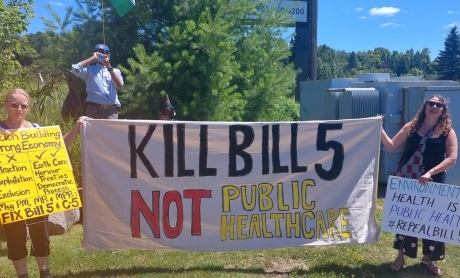
The Ontario Health Coalition rally to protect and improve public healthcare on July 22 in Huntsville outside the premiers’ meetings showed the possibilities. A joint press releaseby health coalitions across the country went beyond simply opposing healthcare privatization:
“While our political leaders talk about new ‘nation-building’ plans, those things that have created equity and a more just society … over the last century are at risk: a world class public health care system; environmental and labour protections; and, the first steps toward reconciliation with First Nations and Indigenous Peoples. If the only pressure our governments feel comes from Donald Trump and the corporate agenda, we will lose what we value most.”
Ramon Kataquapit was invited to speak against Bill 5 at the rally. “Just imagine what will happen next, after they come after us … our land, our treaty rights, our status and our identity as First Nations. Who’s next? … it’s the Canadian people.”
He also spoke about the needs of Indigenous communities in the face of “housing disparities [and] healthcare disparities.” If public healthcare can’t be made accessible and effective for Indigenous people then it is inadequate for everyone.
Struggles for Indigenous sovereignty, climate action, labour solidarity and social justice are bound together in the fight against Carney, Ford, Smith and the corporate agenda.
Support the youth led struggles by donating at these links:
Section:


Featured Event
Events
-
October 18, 2026TkarantoOrganized by:International Socialists
Recent Videos


Visit our YouTube Channel for more videos:

Visit our UStream Channel for live videos: