
|
Columns
You are here
When their laws threaten our bread, and freedom
April 23, 2026
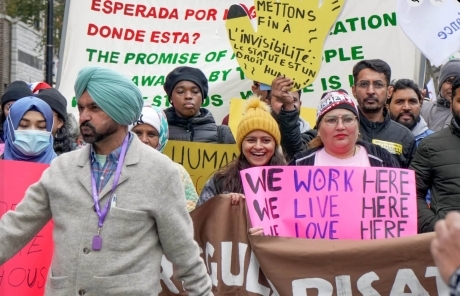
It has been weeks since Bill C 12 came into force.
In Parliament, it was only a vote. Press releases. Smiling government faces before the cameras. Luxurious halls, thick carpets, and calm voices speaking coldly about “management,” “fixing the system,” and “the public interest.”
But outside those walls, the law began another life.
In apartments across Quebec, in damp basement rooms in Montreal, in shared houses in Laval, on farms near Saint Hyacinthe, in student residences in Sherbrooke, and in hotel rooms turned into temporary shelters in Quebec City, people felt it immediately.
They felt it in their chests before they understood it on paper.
They felt it as fear.
For refugees, temporary workers, and international students, laws like this do not arrive as abstract policy. They do not come in constitutional language or legal arguments. They arrive in the middle of the night, when someone wakes suddenly and wonders what if everything ends tomorrow. They arrive as unanswered messages, uncertain appointments, and life plans erased by a single sentence.
The law entered narrow kitchens, where families count what money is left until the end of the month.
It entered bedrooms where three or four people sleep because rent has become impossible.
It entered fields, factories, restaurants, and warehouses.
It entered hearts like a stone.
In Montreal, Nadia wakes before dawn. The light has not yet arrived, and the city is still asleep. She prepares simple sandwiches for her two children, placing them carefully in paper bags, because sometimes love is a piece of bread. She leaves them with a neighbour, then takes two buses to reach her cleaning job.
She wipes the desks of major companies whose owners she will never know. She cleans shining glass that looks over a beautiful city, yet she still feels she is looking at it from the outside.
Nadia came to Canada fleeing repression. She thought fear had been left behind in another country, another language. But she discovered that fear can travel.
It is no longer the sound of bombs or soldiers shouting.
Now it is an email.
Now it is an immigration appointment.
Now it is a missing paper.
Now it is an administrative decision with no eyes and no heart.
Her son asked her last week, while tying his school shoes with trembling hands,
Will they take us from school?
She looked at him for a long moment, straightened the collar of his shirt as if she could repair the world, and did not know how to answer.
In rural Quebec, Harpreet’s day begins at five in the morning. He steps into air so cold it burns the face and climbs onto an old bus carrying the smell of exhaustion. He reaches the farm before sunrise, when the ground is still wet, the sky still grey, and the body not fully awake.
He bends for ten hours a day through mud, water, and cold. He picks vegetables that will be sold in elegant markets, gathering food he himself cannot afford to buy.
His back has hurt for months. He has not asked for rest.
He knows his permit is tied to one employer. He knows that one word, one complaint, one bad mood from the boss could mean losing work, housing, and the right to remain.
Bill C 12 did not create that chain.
It only pulled it tighter.
The state and employers speak about “labour shortages.”
What they really mean is a hand that works, a mouth that stays silent, and a back that keeps bending.
In Sherbrooke, Maria sits in front of a computer late at night. She is trying to finish a university assignment after a long shift in a fast food restaurant. Her feet ache from standing. Her eyes burn from exhaustion. Since morning, she has had only cold coffee and a piece of stale bread.
She came as an international student carrying a simple and noble belief.
That study and hard work could open the door to a better future.
But tuition rises.
Rent rises.
Food prices rise.
And immigration rules change faster than she can understand them.
Every message from immigration makes her heart shake.
Every rumour of new restrictions spreads among students like fire.
Every administrative delay can swallow years of sacrifice in a moment.
These are not isolated stories.
This is how the system works.
Modern capitalism needs migrants, but wants them with fewer rights.
It wants the refugee as a worker, not an equal neighbour.
It wants the student as a customer paying fees, not a human being with a secure future.
It wants the temporary worker as a body that produces, not a voice that protests.
That is why a law like Bill C 12 exists.
To expand the power of refusal, deportation, freezing, and waiting.
To turn life into a long queue of anxiety.
To tell millions of people that their presence depends on obedience.
In Laval, migrant workers labour in warehouses to the point of exhaustion while corporations announce record profits.
In Montreal, families sleep in overcrowded rooms while empty apartments stand as investments.
In Quebec City, people are told migrants are the problem, while those who destroyed housing, healthcare, and public services are the politicians and corporations they serve.
They want workers to blame the weaker, not the richer.
They want working people born here to fear working people who arrived from elsewhere, instead of all of them looking upward, where profits pile up like snow on palace roofs.
But the truth does not live in press conferences.
The truth lives in the street.
The truth is that migrants cook the food, build the homes, clean the hospitals, drive the trucks, care for the elderly, and keep these cities alive.
And another truth is this.
Fear does not last forever.
In recent weeks, we have seen something greater than the law.
Neighbours walking with families to immigration appointments so no one goes alone.
Students sharing food and rent.
Workers speaking in whispers about organizing, then speaking louder.
Community groups translating rights, confronting lies, and breaking isolation.
This is what those in power truly fear.
Not the poor refugee.
Not the exhausted student.
Not the overworked labourer.
What they fear is these people discovering their shared strength.
Bill C 12 came into force weeks ago.
But another reality has also come into force.
Those treated as temporary are the ones who make this society run.
And the day will come when those who plant, carry, clean, and build raise their voices together and say, We will not live in fear anymore.
Section:
Topics:


Featured Event

Events
-
October 18, 2026TkarantoOrganized by:International Socialists
-
October 18, 2026TorontoOrganized by:International Socialists
Recent Videos


Visit our YouTube Channel for more videos:

Visit our UStream Channel for live videos: