|
Reports
You are here
Alberta referendum, the far-right and the tasks ahead
October 21, 2026
The Alberta referendum was always based on a series of myths touted by far-right forces in the province. The leaders of the separatist movement spoke of the absurd idea that Albertans are oppressed within the Canadian state.
This myth exists despite the fact that numbered Treaties 6, 7 and 8 were concluded with the Canadian state prior to the creation of the province of Alberta in 1905, and the First Nations that uphold these treaties have denounced the referendum as a violation of their treaty rightsand the principle of free, prior and informed consent.
Chief Allan Adam of the Athabasca Chipewyan First Nation in Treaty 8 territory explained before the referendum was called. “Our law and protocol demand that if you are considering changes like this, that you come to our leadership first, before opening the question to the public . . . changes to the Treaty relationship without solemn dialogue in the spirit of reconciliation would be a profound breach of Dené law.”
The Treaty 8 First Nations of Alberta changed their name this summer to the Treaty 8 Sovereign Nations to express their opposition to the referendum.
In response, the social media of the separatists escalated anti-Indigenous racism, repeating old slurs and threatening violence against Indigenous leaders.
The vote, championed by the same right wing forces — mainly oil industry groups and executives — supporters of the convoy movement to Ottawa and the peculiar Alberta yellow vest movement wanted to use it to pressure Ottawa for more environment-killing fossil fuel projects.
They needn't have feared. Mark Carney has shown he is absolutely on side with more planet killing projects. He announced the West Coast pipeline as the first project of national interest, expanding fossil fuel infrastructure opposed by Indigenous nations.
Indeed, Carney’s push to the right likely undercut the separation vote and his high approval ratings overall in the context of the threats from Trump played a role in curtailing separatist momentum.
Most media attention focuses on question 10 which asks for a possible referendum to separate from Canada. The results there were clear. 75 percent voted in favour of staying in Canada versus 25 percent calling for withdrawal.
A small hard core drove the separation agenda, likely including people justifiably disenchanted with the Canadian state. Separatist leaders have said they are encouraged by the result and that they’ll continue working to build a majority.
Unfortunately the results from many of the other questions on the survey will result in an increase in racism and oppression of both immigrants and of Indigenous nations within the province.
The first five questions are all related to immigration. Voters were asked about allowing Alberta to reduce immigration numbers, cut services such as healthcare to recent immigrants, charging fees for services for newcomers and requiring voter ID to vote in elections.
Yet on each of these questions a majority voted in favour meaning that many who voted against separating also voted for these racist, anti-immigrant measures. The results of these combined policies will mean a war against immigrants and will provide fodder for the far-right over the next months and years.
Although fewer people voted on these questions overall as compared to the separation question, right wing leaders and provincial parties are already stating that they have a mandate to enact these draconian measures.
Interestingly, Indigenous leaders not only opposed separation but all the referendum questions: for example the Confederacy of Treaty 6 First Nations wrote “These questions do not reflect the spirit of Treaty No. 6, which is about partnership, shared responsibility, and respect for all people within Alberta.”
Canada is a settler-colonial nation based on ethnic cleansing and genocide. A campaign that pitted Canadian nationalism against a racist separation movement could only fuel the anti-immigrant racism that has been embraced by mainstream Canada.
Mark Carney, speaking to reporters after the results were announced, stated that he would be open to discussion on these ideas. He went on to list his own government's recent record in attacking immigrants saying that he has reduced the numbers of asylum seekers, temporary foreign workers and international students by 60 percent or more. He used the same rhetoric of “taking control of immigration” that the far-right has used for years.
The racist far-right will feel emboldened by this result. Groups like the Dominion Society have argued the same anti-immigrant positions to scapegoat immigrants for the cost of living crisis and the deterioration of public services.
We have debunked these claims before — high immigration numbers are actually a boost to the Canadian economy — but the right has no need of such facts. They are appealing to a general state of anger against the system and deliberately misdirecting it.
It is billionaires and complicit governments that have created the cost of living crisis by raising food prices and treating housing as an investment in profit making rather than a human need. The international students coming to Canada brought in more cash to the economy than the entire fossil fuel sector, cash which subsidized the post-secondary education system and helped Canadian born students.
The deterioration of public services is being conducted by the same provincial and federal forces that are attacking immigrants. It is the cuts from Smith and Carney and Ford that are killing healthcare and education. They are simply scapegoating to cover for their own policies.
Fightbacks against privatization, however, did impact the referendum results. Question 8 asked if people supported a constitutional amendment “to allow provinces to opt out of federal programs … such as health care, education, and social services.” A slim majority voted “No”.
The Canadian state is an illegitimate entity based on genocide and exploitation. We didn’t oppose the referendum on the basis of supporting Canadian nationalism but rather because it was, from the beginning, a tool for the growth of the far-right.
Inside and outside of Alberta the tasks remain the same after the referendum result. We need to build the largest possible movement against the far-right. We have to fight back against immigration controls and support the struggles of migrant workers. We have to fight back against cuts to public services and jobs. We have to fight back against attacks on the right to strike and in support of Indigenous sovereignty.
As we see in struggles that are exploding in France, Spain, Italy, India and elsewhere around the world, the only path forward is building and connecting these movements to challenge the system across borders.
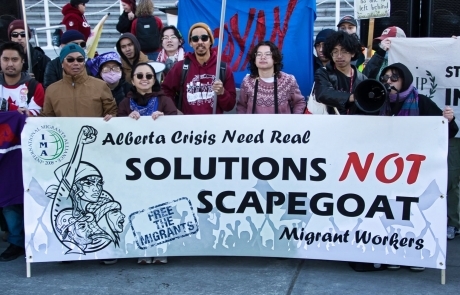
Picture: Migrante Alberta
Section:


Featured Event

Events
-
October 28, 2026VancouverOrganized by:snəw̓eyəɬ leləm̓ Langara International Socialists
-
November 1, 2026TkarantoOrganized by:International Socialists
Recent Videos


Visit our YouTube Channel for more videos:

Visit our UStream Channel for live videos: